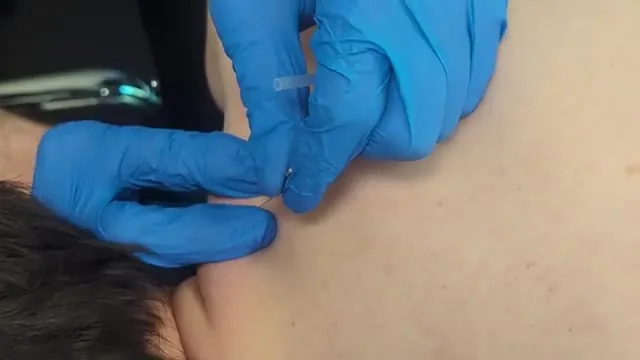
The most common dry needling side effects are muscle soreness for 24 to 48 hours, a small bruise, and feeling a little tired afterward. In a study of 7,629 dry needling treatments, about 1 in 5 caused a minor side effect and none caused a serious one. Most people feel back to normal within two days.
If you are reading this the evening after a session, with a shoulder that feels like it did a hard workout without you, take a breath. What you are feeling is almost always the normal part. Whether you came in for a hamstring that tightens up before race day or a neck that stiffens after a long week at the laptop, the aftermath looks much the same.
In my practice at Helms Performance in Bethesda, MD, the question I hear most the day after a first session is some version of "Is this supposed to feel like this?" The answer is usually yes. Here is how to tell normal soreness from something worth a call, and what helps you feel better faster.
Expect workout-style soreness for a day or two, maybe a bruise, and nothing worse. Anything that is getting worse after 48 hours deserves a call.
What Are the Most Common Dry Needling Side Effects, and How Long Do They Last?
Dry needling places a thin, sterile filament into a tight band of muscle called a trigger point. The muscle releases, then spends a day or so settling down. Most side effects come from that settling, not from anything going wrong.
| Side effect | How common | How long it lasts | What helps |
|---|---|---|---|
| Muscle soreness | Very common | 24 to 48 hours | A walk or an easy jog |
| Bruising | About 1 in 13 treatments | A few days to a week | Nothing needed, it fades on its own |
| A drop of blood at the needle spot | About 1 in 20 treatments | Seconds | Light pressure with a cotton ball |
| Feeling tired or drained | Occasional | The rest of the day | Water, a normal meal, an easy evening |
| Lightheadedness during the session | Uncommon | A few minutes | Lying down, eating beforehand |
| A brief flare of your usual pain | Occasional | A day or two | Easing off hard activity for a day |
Bruising and bleeding rates are from Brady and colleagues (2014), a study of 7,629 dry needling treatments by trained physiotherapists. Your own experience will depend on the area treated and how many spots we work on.
Why Does the Muscle Twitch, and Does It Cause the Soreness?
When the filament reaches a trigger point, the muscle often gives a quick, involuntary jump. This is called a local twitch response: a brief flicker of the muscle fibers that tells us the needle found the spot that has been holding tension. It can feel surprising, like a tiny cramp that lets go a second later.
That twitch is also part of why you feel sore afterward. A muscle that twitches has done a small burst of work, much like a short, intense set at the gym. The soreness comes from that work, and it fades as the muscle settles over the next day or two.
If you want the fuller picture of what the needle is doing, our plain-English guide on how dry needling works walks through it step by step, and does dry needling hurt covers what the session itself feels like.
What Is Not Normal After Dry Needling?
Serious problems after dry needling are rare. In the same 2014 study, none of the 7,629 treatments led to a significant side effect. Still, a good provider tells you the rare possibilities too, so you know what to watch for. Call us if you notice any of these:
- Soreness that is getting worse after 48 hours instead of steadily easing.
- Redness, warmth, swelling, or pus at a needle spot, or a fever. Infection is very rare with sterile, single-use needles, but it is worth checking.
- Numbness, tingling, or weakness that is still there hours after the session.
- A bruise that keeps spreading, especially if you take a blood thinner.
How Can You Recover Faster After a Session?
Most soreness fades on its own. Movement helps it pass faster than rest does, so the advice here is a little different from what people expect.
- Do some light aerobic activity. A 20 to 30 minute walk or an easy jog moves blood through the treated muscle and settles soreness faster than sitting still. This is the single most helpful thing you can do.
- Drink water and eat a normal meal. This helps with the tired, drained feeling some people notice.
- Train, but skip the heavy PR. Moderate weightlifting is fine, even the same day. Just do not go for a personal record or a max-effort lift for 24 to 48 hours while the muscle settles.
- Do the home exercises you were given. The needle helps the muscle let go. The exercises help it stay that way.
- Tell us what you felt. If the soreness felt like too much, we can use fewer needles or a lighter approach next time.
Does Having No Side Effects Mean It Did Not Work?
No. Some people walk out feeling looser and never notice any soreness at all. Others are sore for a day and feel great on day two. Neither pattern predicts how well the treatment worked. What matters is how the area moves and feels over the following week, whether you can turn your head more easily or finish a run more comfortably.
Dry needling is also rarely the whole plan. At Helms Performance, we pair it with hands-on work and a few targeted exercises so the relief lasts. Our dry needling service in Bethesda, MD page explains how a visit works. Every visit is a full hour at a flat fee of $165, and HSA and FSA cards are welcome.
Dr. Paul Helms is a sports chiropractor at Helms Performance in Bethesda, MD, with advanced training in dry needling, Active Release Technique, and sports physical therapy. He works with patients across the whole range, from desk workers and retirees to professional athletes in the NFL and NBA.
Final Thoughts from Dr. Helms
Soreness after dry needling usually means the muscle did some work during the session. Give it a day or two and go for a walk. If it is getting better, you are right on track.
If it is getting worse, or anything on the "not normal" list shows up, call us. That is what we are here for. Whether you are getting back to training or just want to sleep without a knot in your shoulder, we will help you get back to work, back in the game, and back to the activities you love.