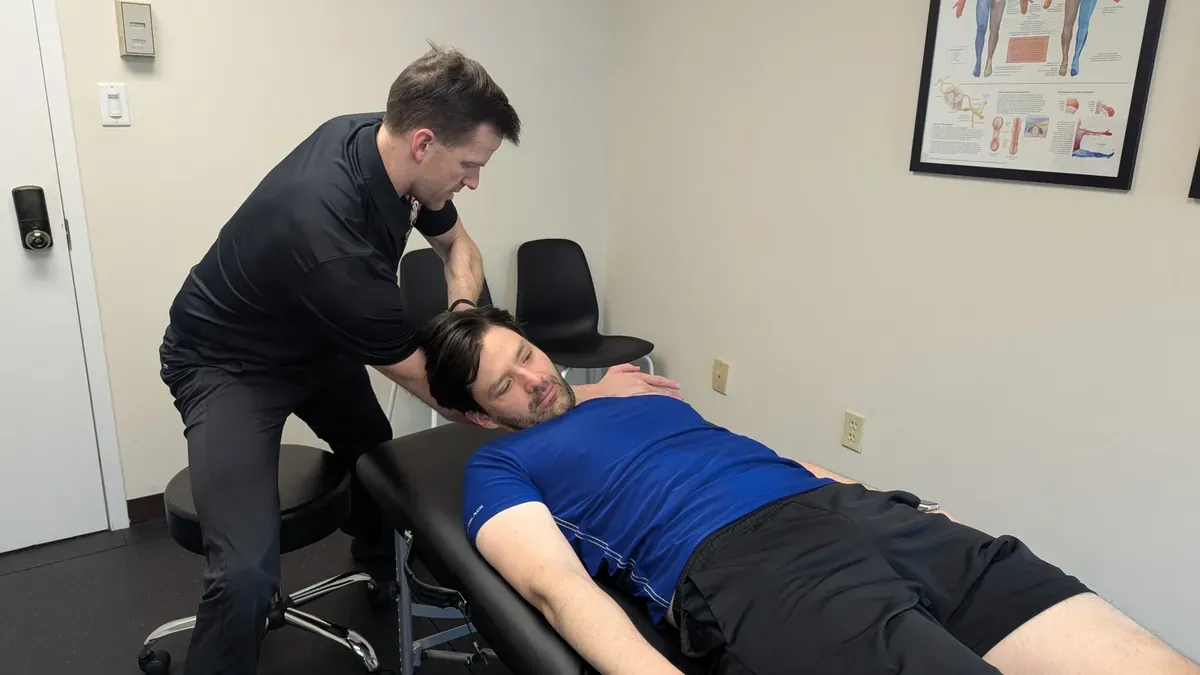
What is BPPV, and how is it treated? +
BPPV, benign paroxysmal positional vertigo, happens when tiny calcium crystals in the inner ear drift out of place and send a false spinning signal when your head changes position. It is the most common cause of vertigo. Treatment is a series of head and body positions, done on the treatment table, that guides the crystals back where they belong. It takes a few minutes and often works in the first session.
Can neck pain cause dizziness? +
Yes. The upper neck is packed with position sensors that tell your brain where your head is. When those joints are stiff or the muscles are tight, from desk posture, a whiplash injury, or years of tension, the signal they send disagrees with your ears and eyes, and that mismatch feels like unsteadiness. This is called cervicogenic dizziness, which simply means dizziness that starts in the neck. It usually improves with hands-on neck care and a short retraining program.
How do I know if my vertigo is from my ear or my neck? +
A few clues help. BPPV brings short, intense spinning, under a minute, set off by lying down, rolling over, or looking up, and it usually comes without neck pain. Neck-related dizziness feels more like floating or unsteadiness, lasts minutes to hours, and travels with neck stiffness, a headache at the base of the skull, or long stretches at a screen. It is usually one or the other. Simple testing at your first visit tells us which.
Does physical therapy help vertigo? +
Yes, for the two most common causes. BPPV responds to a repositioning maneuver, and most patients feel a clear difference within one to three visits. Neck-related dizziness improves with hands-on care, dry needling where it fits, and neck retraining exercises. Vertigo caused by migraine, medication, blood pressure, an inner ear infection, or a neurological condition needs a physician or an ENT (an ear, nose, and throat specialist) involved. We screen for those first and point you in the right direction.
How long does it take for vertigo to go away with treatment? +
It depends on the cause. BPPV often settles in one to three repositioning visits, with some wooziness for a few days after. Neck-related dizziness usually improves over two to six weeks of care and home exercise. Dr. Helms gives you a realistic timeline after your first visit, not an open-ended course of care.
What should I avoid after BPPV treatment? +
For the rest of the day, take it easy and avoid quick head movements, bending to the floor, or tipping your head far back. Sleeping slightly propped up the first night helps some people. You do not need to hold still, and normal walking is fine. Some wooziness for a day or two is expected. If the spinning comes back, let us know, since a second treatment is sometimes needed.
Can a chiropractor help with vertigo? +
Yes, when the vertigo comes from BPPV or the neck, and when the chiropractor is trained to tell the difference. Chiropractic care helps neck-driven dizziness by restoring movement in the upper cervical joints and easing the muscles that feed your brain a faulty position signal. For BPPV, the repositioning maneuver is the treatment, not an adjustment. Dr. Helms uses both chiropractic and physical therapy so the right tool is used for the right cause.
Can a chiropractor make vertigo worse? +
It should not, and screening is what prevents it. A dizzy patient should not receive a quick, high-speed neck adjustment before the cause is known. At Helms Performance, every vertigo visit starts with red-flag screening and positional testing, and any neck work is gentle and specific. If anything in your history points to a cause that needs a physician, you are referred first.
Is vertigo dangerous? When should I go to the ER instead? +
Most vertigo is not dangerous, but some causes are. Go to the emergency room or call 911 if dizziness comes with a sudden severe headache, double vision, slurred speech, facial drooping, weakness or numbness on one side, trouble walking, chest pain, or new hearing loss. Those are not symptoms to book an appointment for. For spinning that starts when you change position and passes within a minute or two, or unsteadiness that travels with a stiff neck, vertigo physical therapy is the right place to start.
How much does vertigo physical therapy cost in Bethesda? +
Every visit at Helms Performance is a flat $165 for a one-hour, one-on-one appointment with Dr. Helms. Vertigo testing, the repositioning maneuver, neck treatment, and your home program are all included. We do not bill insurance directly, but you can pay with an HSA or FSA card and we provide a superbill, an itemized receipt you can submit to your insurer for reimbursement.