Wrist Pain Relief · Bethesda, MD

Wrist Pain Relief
in Bethesda, MD

Whether you're a rock climber dealing with ulnar wrist pain that limits your training, or someone whose wrist aches after a long day of typing and hasn't improved with rest, Dr. Paul Helms combines sports chiropractic and physical therapy to find the source of your wrist pain and help you get back to the activities you love.

One-on-one with Dr. Helms Sports chiro + physical therapy Bethesda, MD
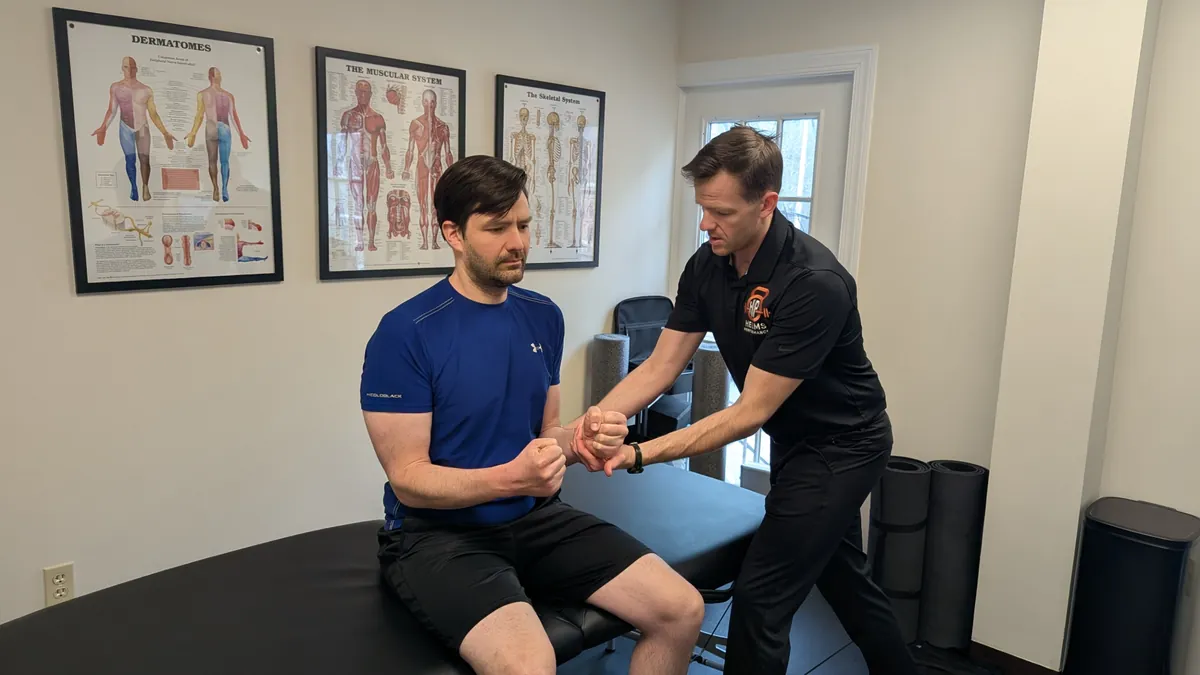
Dr. Paul Helms treating wrist pain at Helms Performance in Bethesda, MD
One-on-one every visit
Same-week appointments available
Bethesda, MD

Relieve pain

We find the specific structure driving your wrist pain and use hands-on care to start relieving it from the first visit.

Restore movement

We restore the range of motion and wrist mobility you need to work, train, and move through your day comfortably.

Rebuild strength

We rebuild grip strength and the wrist stability that protects you from re-injury when you return to full activity.

Understanding Your Wrist Pain

What Causes Wrist Pain?

Wrist pain is easy to ignore at first. It shows up as a dull ache when you lift something, a sharp pinch when you rotate your forearm, or a persistent throb at the end of a long day at the keyboard. By the time most patients come to see Dr. Helms at Helms Performance in Bethesda, MD, they have been managing around it for weeks or months.

The wrist is one of the most mechanically complex joints in the body: eight carpal bones, multiple tendons crossing from the forearm, and several distinct ligament structures, each of which can become a source of pain on its own.

Whether the pain is on the pinky side of the wrist, the thumb side, the palm, or deep in the joint, a thorough assessment is the only reliable way to identify what is actually causing it and what the right treatment approach should be.

Dr. Helms' Clinical Observation
The most common presentation I see with wrist pain involves restricted soft tissue on the ulnar side of the wrist, reduced mobility through the carpal joints, and a forearm that has been compensating for both. Treating all three together consistently produces better results than addressing any one in isolation.
Dr. Paul Helms, Sports Chiropractor, Helms Performance, Bethesda MD
1

Identify which structure is involved

The wrist has multiple potential pain sources: ligaments, tendons, carpal bones, and nerve tissue. Finding the right one before treating prevents wasted time and missed causes.

2

Address the joint, the soft tissue, and the forearm together

Wrist pain rarely lives in the wrist alone. Tight forearm muscles, restricted carpal joints, and nerve involvement from the elbow or neck are common contributors that need to be assessed.

3

Rebuild so the pain does not return

Restoring grip strength and wrist stability alongside pain relief is what makes the improvement last, whether you are returning to sport, a keyboard, or a physical job.

Chiropractic vs. Physical Therapy for Wrist Pain
Approach What it addresses
Chiropractic Carpal joint restriction, cervical nerve root compression, ulnar and median nerve involvement
Physical therapy Grip strength, wrist mobility, forearm muscle balance, movement pattern correction
Helms Performance Both disciplines under one roof, every layer of the problem addressed together
Who It Helps

Wrist Pain We Treat in Bethesda, MD

Whether you are dealing with a specific sports injury, a work-related strain, or wrist pain that has been building gradually without a clear cause, Dr. Helms has worked with patients across the full range of wrist conditions.

Ulnar Wrist Pain

Pain along the pinky side of the wrist is one of the most common wrist complaints Dr. Helms sees. It often involves the TFCC, a group of ligaments and cartilage that stabilizes the wrist, or the tendons that run along the ulnar side of the forearm.

TFCC Injury

The triangular fibrocartilage complex can be torn acutely or worn down over time. Pain with forearm rotation or gripping, especially on the pinky side, is a hallmark sign. Many TFCC injuries respond well to conservative care without surgery.

Carpal Tunnel Syndrome

Numbness, tingling, or weakness in the thumb, index, and middle fingers points to the median nerve being compressed as it passes through the carpal tunnel. Soft tissue work and wrist mobilization can relieve pressure on the nerve and reduce symptoms.

De Quervain's Tenosynovitis

Pain and tenderness on the thumb side of the wrist, often worse when making a fist or gripping, is a sign of de Quervain's, an irritation of the tendons that control thumb movement. It is common in new parents and anyone who lifts or carries repeatedly.

Wrist Tendinitis

Repetitive motion from typing, sport, or manual work can inflame the tendons crossing the wrist. The pain often builds gradually and worsens with use, then improves with rest, only to return the next day at the keyboard or on the court.

Wrist Sprains and Strains

A fall on an outstretched hand, a sudden twist, or a missed catch can stretch or partially tear the ligaments of the wrist. Pain with weight-bearing through the hand, swelling, and reduced grip strength are typical signs. Early treatment helps prevent chronic instability.

Wrist Pain from Typing and Desk Work

Sustained keyboard and mouse use in a fixed position puts cumulative stress on the wrist tendons, carpal joints, and forearm muscles. Pain that worsens through the workday and improves on weekends is a reliable sign that posture and load management need to be part of the plan.

Wrist Pain from Sport or Training

Climbing, gymnastics, tennis, weightlifting, and CrossFit all put the wrist under significant load. Acute injuries and chronic overuse both respond well to a combination of soft tissue care, joint mobilization, and a structured return-to-training plan.

Your First Visit

What to Expect From Your First Appointment

A first visit with Dr. Helms is about understanding your wrist fully. Most patients receive hands-on care at the first appointment and leave with a clear understanding of what is causing the pain and what the path forward looks like.

  1. 1

    We listen to your history

    When it started, what makes it better or worse, what you have already tried, and what you are hoping to get back to. The history often points directly to what is driving the pain.

  2. 2

    We assess the wrist and everything connected to it

    Your carpal joints, forearm soft tissue, grip strength, and cervical spine are all part of the picture. Wrist pain is rarely limited to the wrist, and we do not treat it like it is.

  3. 3

    We provide hands-on care

    Most patients receive treatment at the first visit, whether that is soft tissue work with Active Release Technique, joint mobilization, or a combination. You do not have to wait until a second or third appointment to feel progress.

  4. 4

    We explain what we found and what comes next

    You will leave knowing what we believe is contributing to your wrist pain, what we are going to do about it, and a realistic sense of how long recovery should take for your specific situation.

Thorough assessment

Wrist, forearm, elbow, and cervical spine evaluated together, not in isolation.

Hands-on from visit one

Most patients receive Active Release Technique or joint mobilization at the first appointment.

A clear plan from day one

You will leave understanding what is causing your wrist pain and what recovery looks like for your situation.

Dr. Paul Helms, sports chiropractor and physical therapist at Helms Performance in Bethesda, MD
Dr. Paul Helms Sports Chiropractor, Bethesda MD
Your Provider

Dr. Paul Helms

Dr. Paul Helms has been helping people in Bethesda, MD move better and feel better for years. Whether you are an athlete whose wrist pain is limiting your training, or someone whose wrist has been bothering them through every workday and you are not sure why, Dr. Helms brings the same level of attention and care to every patient, every visit.

Dr. Helms has advanced training in Active Release Technique, a massage and movement-based method that treats problems with muscles, tendons, ligaments, fascia, and nerves. He has worked with patients ranging from desk workers and new parents to competitive climbers and professional athletes in the NFL, NBA, and CrossFit. He frames that experience as range, not as a filter.

At Helms Performance, you see Dr. Helms one-on-one at every appointment. The same doctor who assesses your wrist builds your plan and carries it out, start to finish.

  • Doctor of Chiropractic
  • Licensed in dry needling
  • Sports physical therapy training and application
  • Certified in Active Release Technique and Fascial Stretch Therapy
  • Experience with patients ranging from weekend runners to NFL and NBA athletes
  • Located at 7625 Wisconsin Ave, Suite 219, Bethesda, MD 20814
Related Conditions

Wrist pain often connects to what is happening in the elbow, shoulder, or neck. Dr. Helms treats the full kinetic chain, not just where the pain shows up.

Common Questions

Wrist Pain FAQs

What causes ulnar wrist pain?

Ulnar wrist pain, felt along the pinky side of the wrist, most often comes from injury or irritation to the TFCC, a group of ligaments and cartilage that stabilizes the wrist joint. Other common causes include ECU tendinitis, affecting the tendon that runs along the back of the ulnar wrist, and ulnar impaction syndrome, where the ulna bone presses against the adjacent carpal bones. At Helms Performance in Bethesda, MD, Dr. Paul Helms assesses the specific structures involved before building a treatment plan, because the right care depends entirely on what is actually causing the pain.

Can a chiropractor help with wrist pain?

Yes. Chiropractic care is effective for wrist pain that involves carpal joint restriction, nerve compression from the cervical spine, or thoracic outlet involvement. At Helms Performance, Dr. Paul Helms combines chiropractic with Active Release Technique and physical therapy under one roof, addressing the wrist joint, the surrounding soft tissue, and the movement patterns that may be contributing to the problem, all in one place without referrals to separate providers.

What is the difference between ulnar wrist pain and carpal tunnel syndrome?

Carpal tunnel syndrome involves the median nerve and produces symptoms on the thumb side of the wrist and hand, including numbness and tingling in the thumb, index, and middle fingers. Ulnar wrist pain involves the pinky side of the wrist and hand, and when a nerve is involved, the ring and little fingers are typically affected. The two conditions require different treatment approaches. A thorough evaluation is the only reliable way to distinguish between them, because symptoms can overlap and both can sometimes be present at the same time.

What is TFCC and can it heal without surgery?

The TFCC, or triangular fibrocartilage complex, is a group of ligaments and cartilage on the ulnar side of the wrist that stabilizes the joint and cushions the carpal bones during rotation and gripping. TFCC tears are a common source of ulnar wrist pain. Many TFCC injuries, particularly partial tears and degenerative changes, can improve significantly with conservative care including chiropractic, Active Release Technique, and physical therapy. Surgery is typically considered when conservative treatment has not produced adequate improvement after several months of consistent care.

How long does wrist pain take to heal?

Recovery time depends on what is causing the pain and how long it has been present. Acute wrist sprains often improve within a few weeks with the right care. Chronic conditions like TFCC injury, de Quervain's tenosynovitis, or carpal tunnel syndrome generally take longer, often eight to twelve weeks of consistent treatment. Early care consistently produces faster results because chronic pain tends to involve more layers of restriction and compensatory movement patterns that take more time to address.

When should I see someone for wrist pain?

Wrist pain that follows a fall or direct impact and comes with visible deformity, severe swelling, or inability to bear any weight through the hand should be evaluated promptly to rule out a fracture. Wrist pain that persists beyond two to three weeks, worsens over time, or significantly limits daily activities is worth having assessed rather than managed with rest alone. At Helms Performance in Bethesda, MD, Dr. Paul Helms can evaluate your wrist and help you understand what is causing the pain and what a realistic path forward looks like for your situation.

Ready to Feel Better?

Wrist pain does not have to be something you manage around. Dr. Helms will help you find the source, get you moving comfortably again, and build the strength to keep it from coming back. We will help you get back to work, back to training, and back to the activities you love.

Book An Appointment

Or call 301-578-5197 to speak with our team