Elbow Pain Relief ยท Bethesda, MD

Elbow Pain Relief
in Bethesda, MD

Whether you're a lifter dealing with elbow pain when lifting heavy, or a desk worker whose forearm aches after a long day at the keyboard, the discomfort has a way of following you through everything you do. Dr. Paul Helms identifies the specific source of your pain and builds a care plan that gets you back to moving freely.

One-on-one with Dr. Helms | Sports chiro + physical therapy | Bethesda, MD
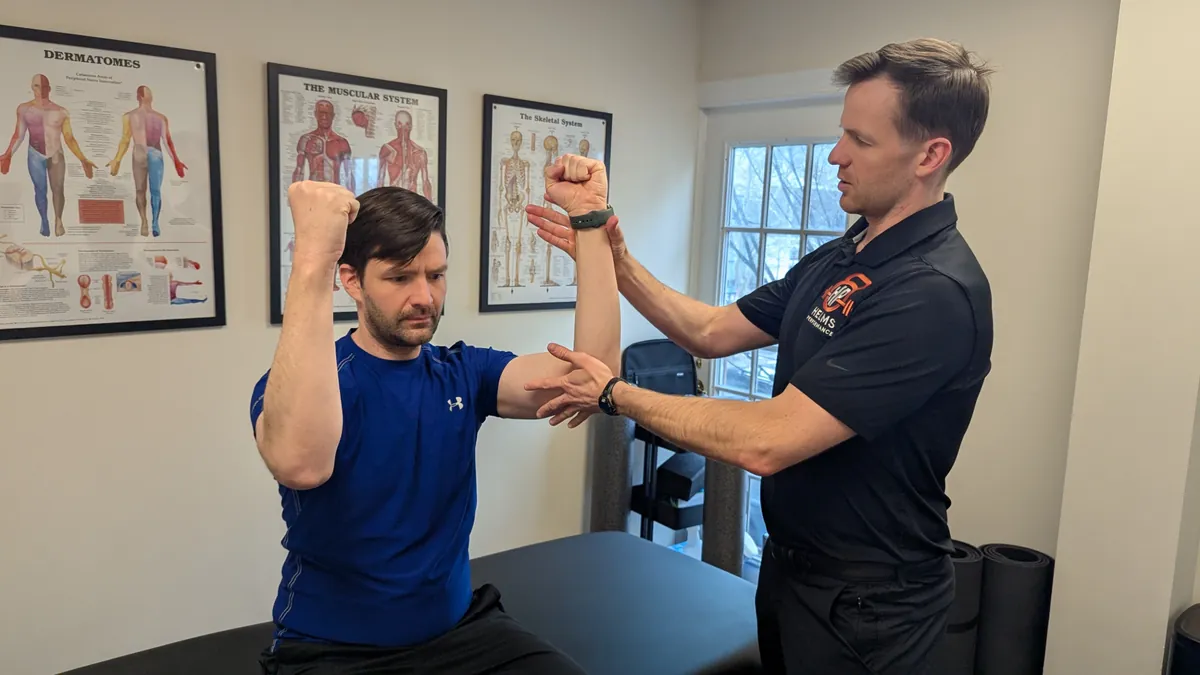
Elbow pain treatment at Helms Performance in Bethesda, MD
One-on-one every visit
Same-day appointments available
Bethesda, MD

Relieve pain

Targeted soft tissue work, Active Release Technique, and chiropractic care address the source of your elbow pain, not just the symptom.

Restore movement

Bring back the full range of motion your elbow needs, whether for lifting, gripping, reaching, or just getting through the day comfortably.

Rebuild strength

Build the forearm and shoulder strength that keeps elbow pain from coming back, so you stay out of pain for the long term.

Understanding Your Pain

What Is Causing Your Elbow Pain?

Elbow pain is often misread as a single condition when it actually comes from several very different sources. The elbow is where the bones, tendons, and nerves of the forearm and shoulder converge. Tennis elbow and golfer's elbow are the most common diagnoses. Both are overuse injuries to the tendons on the outer or inner side of the joint. Elbow pain can also come from nerve compression in the cubital tunnel (the channel on the inner elbow where the ulnar nerve passes), joint inflammation, bursitis, or pain referred from tight structures in the neck or shoulder.

The location of your pain matters: inside, outside, or deep in the joint. So does when it appears, whether that is during bending, straightening, lifting, or gripping. Without that picture, treatment is guesswork. Dr. Helms uses hands-on assessment to determine exactly what is involved before any treatment begins.

He uses chiropractic care for elbow pain alongside Active Release Technique (a massage and movement-based technique that treats problems with muscles, tendons, ligaments, fascia, and nerves) and sports physical therapy to address the root cause and build the strength to prevent it from returning.

In My Practice, Bethesda MD

The patients I see most often with elbow pain when lifting have one thing in common: they have been managing the symptoms for weeks or months before coming in. By then, the tendon has adapted in ways that a simple rest-and-ice approach will not address. Getting an accurate picture early, whether the issue is the extensor tendon on the outside, the flexor tendon on the inside, or the ulnar nerve running behind the elbow, changes the treatment approach and usually shortens recovery significantly.

Dr. Paul Helms, DC, Helms Performance, Bethesda MD
1
Movement and Load Assessment Dr. Helms tests range of motion, grip strength, and specific movements to isolate the exact source of your pain.
2
Soft Tissue and Nerve Evaluation Hands-on assessment identifies which tendon, muscle, joint, or nerve is involved and how it connects to your pain pattern.
3
Targeted Treatment Treatment is chosen based on your specific findings, not a generic protocol. That may include Active Release Technique, chiropractic joint work, or soft tissue therapy.
Tennis Elbow vs. Golfer's Elbow

Tennis elbow (lateral epicondylitis) causes pain on the outside of the elbow when gripping or lifting. Golfer's elbow (medial epicondylitis) causes pain on the inside. Both are tendon overuse injuries, but they involve different muscles and respond to different treatment approaches. Dr. Helms assesses both carefully before treating.

Know the Difference

Tennis Elbow, Golfer's Elbow, and Cubital Tunnel: Side by Side

Three of the most common elbow conditions share overlapping symptoms but have different causes and different treatments. Understanding which one you have is the first step to resolving it.

Condition Where It Hurts Common Cause Key Symptoms Dr. Helms's Approach
Outer Elbow Tennis Elbow Lateral Epicondylitis Outside of the elbow, often radiating into the forearm Repetitive gripping, lifting, or wrist extension. Common in desk workers, weightlifters, and racket sport players Pain when lifting objects, shaking hands, turning a doorknob, or typing Active Release Technique to the extensor tendons, joint mobilization, progressive forearm loading
Inner Elbow Golfer's Elbow Medial Epicondylitis Inside of the elbow, sometimes into the forearm and wrist Repetitive gripping, throwing, or wrist flexion. Common in people who lift, swing, or type for extended periods Pain on the inner elbow when gripping or lifting, morning stiffness, tenderness to the touch Soft tissue work and ART to the flexor tendons, grip-strengthening protocol, load management
Nerve Cubital Tunnel Syndrome Ulnar Nerve Entrapment Inner elbow, radiating to the ring and pinky fingers Prolonged elbow bending, leaning on the inner elbow, or repetitive flexion throughout the day Tingling or numbness in the ring and pinky fingers, pain when bending the elbow, symptoms worse at night Nerve mobilization, soft tissue release around the cubital tunnel, ergonomic and positioning guidance

Not sure which one you have? A hands-on assessment is the most accurate way to find out. Book an appointment and Dr. Helms will assess the specific source of your elbow pain at your first visit.

Who We Help

Types of Elbow Pain We Treat

Elbow pain looks different from person to person. Whether your pain is on the inside, outside, or deep in the joint, and whether it shows up when lifting, typing, or just bending your arm, Dr. Helms will identify what is driving it and build a plan around your specific situation.

Tennis Elbow

Pain and tenderness on the outer elbow, often felt when lifting, gripping, or turning the wrist. Common in athletes and desk workers alike, not just tennis players.

Golfer's Elbow

Pain and soreness on the inside of the elbow. Caused by repetitive gripping, lifting, or throwing, but also frequent in people who type or work with their hands.

Cubital Tunnel Syndrome

Nerve compression at the inner elbow that causes pain, numbness, or tingling when the arm is bent. Often worse at night or after holding the elbow in a flexed position for a long time.

Elbow Pain When Lifting or Gripping

Pain that appears specifically during lifting, carrying, or gripping can point to tendon irritation, joint stress, or nerve involvement. Dr. Helms assesses all three.

Elbow Pain When Bending and Straightening

Limited range of motion with pain through the arc of movement is often related to cubital tunnel syndrome, bursitis, or joint irritation. Each has a different cause and different treatment.

Olecranon Bursitis

Swelling and tenderness at the tip of the elbow caused by inflammation of the small fluid sac over the joint. Often sensitive to the touch and worsened by leaning on hard surfaces.

Elbow Joint Pain and Arthritis

Stiffness, a deep aching, or a grinding sensation inside the joint. Can develop gradually from wear over time or after a previous injury that was never fully resolved.

Referred Elbow Pain

Pain originating in the neck, shoulder, or forearm can travel to the elbow. If your symptoms do not fit a clear pattern, referred pain is often worth investigating.

Your First Visit

What to Expect From Your First Appointment

Your first appointment is an assessment as much as it is a treatment. Dr. Helms will listen to your history, assess your movement, and identify the specific source of your elbow pain before any hands-on work begins. You will leave with answers, not just temporary relief.

  1. History and Goals

    We start by listening. We want to know what makes it better or worse, when it started, and what you want to get back to doing comfortably.

  2. Movement and Load Assessment

    Dr. Helms tests range of motion, grip strength, and specific movements to isolate the structure that is generating your pain.

  3. Hands-on Treatment

    Active Release Technique, soft tissue work, or chiropractic joint care, chosen based on your assessment, starts at the first visit.

  4. Your Recovery Plan

    You leave with a clear picture of what is causing your pain and a realistic plan, with timelines you can count on.

Dr. Paul Helms, sports chiropractor and physical therapist at Helms Performance in Bethesda, MD
Dr. Paul Helms Sports Chiropractor, Bethesda MD
Your Provider

Dr. Paul Helms

Dr. Helms has worked with patients ranging from weekend runners and desk workers to professional athletes in the NFL and NBA. He approaches chiropractic care for elbow pain the same way he approaches every condition: find the root cause, treat it directly, and build the strength to keep it from coming back. Whether your pain developed from hours at a keyboard or years of throwing, you are in the right place.

Every appointment is one-on-one. Every plan is built around your goals and your activity level, not a standard protocol. He brings the same thorough approach to elbow pain that he applies across every condition he treats.

  • Doctor of Chiropractic
  • Licensed in dry needling
  • Sports physical therapy training and application
  • Certified in Active Release Technique and Fascial Stretch Therapy
  • Experience with patients ranging from weekend runners to NFL and NBA athletes
  • Located at 7625 Wisconsin Ave, Suite 219, Bethesda, MD 20814
Learn About Dr. Helms
Common Questions

Elbow Pain FAQs

Answers to the questions we hear most often, so you know exactly what to expect before you come in.

What causes elbow pain when lifting?

Elbow pain when lifting most often comes from the tendons on the outer or inner side of the joint, specifically lateral epicondylitis (tennis elbow) on the outside or medial epicondylitis (golfer's elbow) on the inside. Both are overuse injuries that develop when the tendons are loaded repeatedly without enough recovery. Nerve compression at the inner elbow, known as cubital tunnel syndrome, can also contribute during lifting if the ulnar nerve is irritated. A hands-on assessment is the most reliable way to identify which structure is involved.

What is the difference between tennis elbow and golfer's elbow?

Tennis elbow (lateral epicondylitis) causes pain on the outside of the elbow, where the extensor muscles of the forearm attach to the bone. Golfer's elbow (medial epicondylitis) causes pain on the inside, where the flexor muscles attach. Both are overuse injuries to the tendons and are common in people who have never played either sport. Dr. Helms treats both with a combination of Active Release Technique, soft tissue work, and targeted strengthening.

Why does my elbow hurt when I bend and straighten it?

Pain through the range of motion is often a sign of cubital tunnel syndrome, where the ulnar nerve is compressed or irritated at the inner elbow. It can also point to joint irritation, bursitis, or a tight forearm muscle that limits smooth movement. If the pain is accompanied by tingling in the ring or pinky finger, nerve involvement is likely. Dr. Helms will assess the full picture to find the specific source.

Why does my elbow hurt when I lift or grip?

Lifting and gripping load the tendons on both sides of the elbow. Pain with these movements most often points to tennis elbow (outer side) or golfer's elbow (inner side), though nerve compression or joint stress can also be involved. The exact location of the pain, inner, outer, or deep in the joint, helps narrow down the cause quickly.

Can carpal tunnel syndrome cause elbow pain?

Carpal tunnel syndrome is a nerve compression at the wrist, not the elbow, so it does not directly cause elbow pain. However, the same repetitive strain patterns that lead to carpal tunnel can also irritate tissues at the elbow. Some people experience what is called a double crush pattern, where a nerve is compressed at more than one point along its path. If you have both wrist and elbow symptoms, a thorough assessment can clarify what is driving each.

How long does elbow pain take to resolve with treatment?

It depends on how long the problem has been present and how your body responds. Many patients notice meaningful improvement after two to four sessions. Chronic tendon conditions, those that have been present for months, often take longer because the tissue has had more time to adapt. After your first appointment, Dr. Helms will give you a clear, realistic picture of what to expect, not an open-ended course of care.

Related Conditions

Elbow pain often connects to issues at the wrist, shoulder, or neck. If symptoms are spreading or you're not sure what's driving the problem, Dr. Helms will assess the full picture.

Let's Help You Feel Better.

Elbow pain rarely resolves on its own. The sooner you understand what is driving it, the faster you can get back to lifting, typing, carrying, and moving the way you want to. We will help you get back to work, back in the game, and back to the activities you love.

Book An Appointment

Or call 301-578-5197 to speak with our team