Knee Pain Relief · Bethesda, MD

Knee Pain Relief
in Bethesda, MD

Whether you are a runner whose knee gives out at mile three, a desk worker whose knees ache on the stairs, or someone who has been managing knee pain for years, Dr. Paul Helms can help. At Helms Performance in Bethesda, MD, we combine sports chiropractic and physical therapy to find the source of your knee pain and build a plan to get you moving comfortably again.

One-on-one with Dr. Helms | Sports chiro + physical therapy | Bethesda, MD
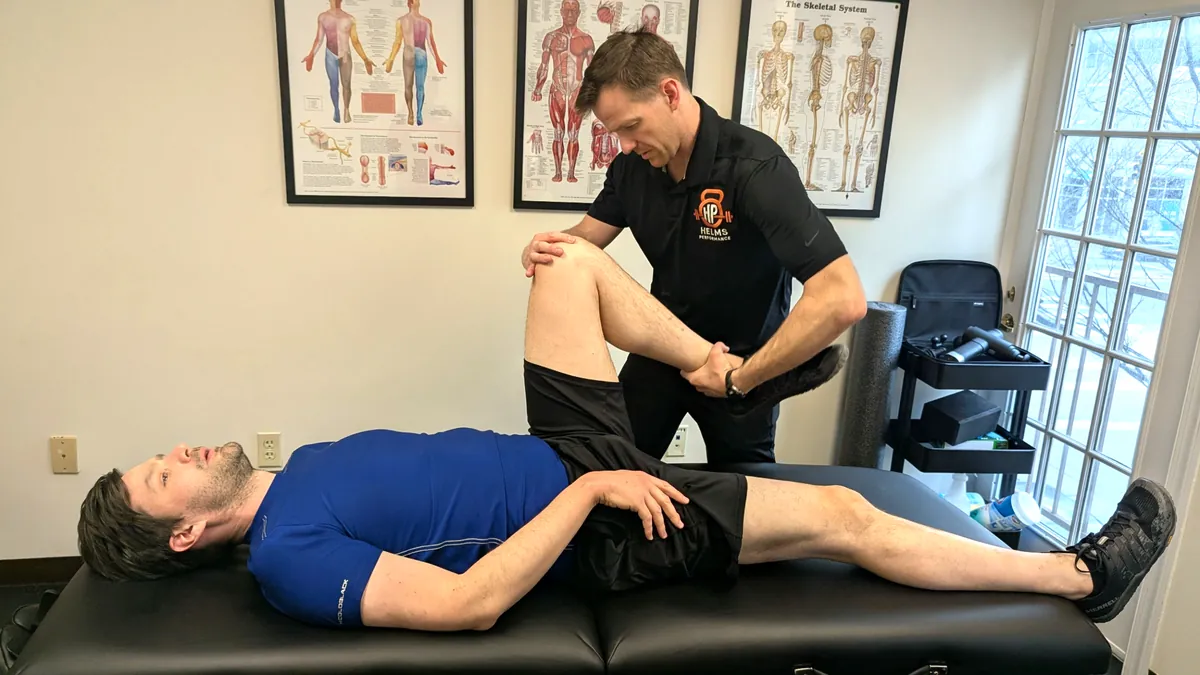
Knee pain treatment at Helms Performance in Bethesda, MD
One-on-one every visit
Same-day appointments available
Bethesda, MD

Our Approach to Knee Pain

Relieve pain

We start by finding the source of your knee pain, whether it is the joint, the surrounding soft tissue, or a movement pattern driving the load. Then we address it directly.

Restore movement

Once pain settles, we work on how your knee bends, straightens, and loads so you can move without guarding. Stairs, squats, and walking should feel natural again.

Rebuild strength

The muscles around your knee protect it. We help you build the hip and quad strength that keeps pain from returning, not just the kind that passes in a few weeks.

Understanding Your Knee Pain

Why Does Your Knee Hurt?

The knee is one of the most loaded joints in the body, bearing roughly three to four times your body weight with each step. When something goes wrong, pain can show up in many places: behind the knee, on the inside or outside edge, or deep in the joint when you bend or squat.

At Helms Performance, Dr. Helms starts every knee pain evaluation by looking beyond the knee itself. The hip, foot, and lumbar spine all influence how the knee loads with every step. A weak hip abductor or a stiff ankle can quietly shift forces into the knee across thousands of repetitions, creating pain that feels like a knee problem but originates elsewhere in the chain.

Whether your pain came on after a run, appeared gradually over months, or has been present for years without a clear cause, the first step is understanding exactly which structure is under stress and why. That is what drives the treatment plan, not just where you feel it.

"The most common pattern I see at Helms Performance in Bethesda is a hip weakness problem driving abnormal load into the knee. The knee is where the pain is. It is rarely where the problem starts. The three things I evaluate in every knee assessment: (1) how the knee loads relative to the hip and foot, (2) which soft tissue structure is restricted and under stress, and (3) whether the lumbar spine is contributing through referred nerve irritation. Two of those three are usually outside the knee itself."

Dr. Paul Helms, Sports Chiropractor
1
Full Movement Assessment Dr. Helms evaluates the knee, hip, and foot together to find where forces are concentrating and why, not just where it hurts.
2
Targeted Hands-on Treatment A combination of joint mobilization, Active Release Technique, and soft tissue work addresses the source of the problem directly.
3
Strength and Movement Rehab Specific exercises rebuild the hip, quad, and calf strength that protect the knee and help you stay active long-term.
Sports Chiropractic vs. Physical Therapy for Knee Pain

At Helms Performance, you do not have to choose. Both disciplines work together under one roof, so you get joint mechanics and movement rehabilitation in the same appointment, with the same provider.

Sports Chiropractic vs. Physical Therapy: What Is the Difference?

Two distinct disciplines. Both available at Helms Performance. Often used together for the best outcome.

Category Sports Chiropractic Physical Therapy
Focus Joint mechanics, nerve function, and spinal alignment as it affects the knee Movement rehabilitation, restoring muscle strength, and functional movement patterns
Methods Joint adjustments, Active Release Technique, soft tissue and nerve work Exercise therapy, neuromuscular training, and movement pattern correction
Best for Joint restriction, nerve-referred pain, mechanical knee pain, lumbar involvement Muscle weakness, post-injury rehab, movement dysfunction, and long-term prevention
Timeline Often provides faster initial relief for joint and nerve-driven pain Builds the durable strength that protects the knee over the long term
Location Guide

Knee Pain Location Chart: What Your Pain Location Tells You

Where you feel knee pain is one of the first clues to what is causing it. Different structures, including the joint, ligaments, tendons, and bursae, each have a distinct location. Whether you are a runner dealing with outer knee pain, a desk worker with stiffness behind the knee, or someone whose knees ache going down stairs, this chart is a starting point. Dr. Helms will evaluate the full picture during your first visit.

Pain Location What It May Indicate Common In How Dr. Helms Helps
Front of the knee / kneecap Patellofemoral syndrome, patellar tendinopathy Cyclists, stair climbers, desk workers who sit for long periods with knees bent Kneecap tracking correction, quad and hip strengthening, soft tissue release
Inside of the knee (medial) MCL strain, pes anserine bursitis, medial meniscus involvement Runners, walkers, people who recently increased their activity level Targeted soft tissue work, load management, hip abductor strengthening
Outside of the knee (lateral) IT band syndrome, LCL irritation Runners, cyclists, and hikers Active Release Technique on the IT band, hip and glute strengthening, gait correction
Behind the knee Baker's cyst, popliteal strain, hamstring tendon issues People who sit for long periods, runners, anyone with joint swelling Identify the underlying joint cause, soft tissue work, movement pattern correction
Below the kneecap Patellar tendinitis (jumper's knee) Athletes who jump or squat frequently, people recently returning to exercise Eccentric loading protocol, tendon rehabilitation, biomechanical correction
Deep inside the joint Meniscus damage, arthritis, general joint inflammation Older adults, people with chronic pain, post-injury patients Joint mobilization, inflammation management, strengthening to offload the joint

This chart is a reference, not a diagnosis. Knee pain rarely involves one structure in isolation. A full evaluation at Helms Performance will tell you exactly what is happening and why.

Who We Help

Types of Knee Pain We Treat

Whether your knee pain came on after a specific event or has been building quietly for months, Dr. Helms works with patients across all activity levels, from competitive athletes to people who want to walk to the mailbox without discomfort.

Pain Behind the Knee

Pain at the back of the knee often involves the popliteal region, hamstring tendons, or a Baker's cyst. It is common in runners and people who sit for long periods and notice stiffness when they stand.

Inner Knee Pain (Medial)

Medial knee pain, felt on the inside of the knee, often involves the MCL, pes anserine tendons, or the medial meniscus. It is a frequent complaint in people who walk or run regularly or have recently increased their activity.

Outer Knee Pain (Lateral)

Lateral knee pain on the outside of the knee is often related to IT band tightness or the LCL. IT band syndrome is one of the most common overuse injuries in runners and cyclists.

Knee Pain When Bending

Pain that comes on when you bend, squat, or descend stairs often points to the patellofemoral joint (the kneecap and the groove it tracks in) or the patellar tendon. Meniscus involvement is also possible, depending on the location.

Knee Pain When Walking

Knee pain that worsens with walking or prolonged standing may involve joint inflammation, soft tissue tightness, or problems with how the hip and foot are distributing load through the knee with each step.

Knee Pain After Running

Runner's knee (patellofemoral pain syndrome), IT band syndrome, and patellar tendinopathy are the most common culprits. Running-related knee pain usually responds well to soft tissue work combined with biomechanical correction.

Knee Pain Without an Injury

Knee pain that appears without a clear incident is very common. Arthritis, gradual joint degeneration, and cumulative overuse can all develop without any single event. The absence of a specific injury does not mean the cause is unclear, just that the investigation starts differently.

Knee Pain in Women

Women tend to have a wider hip angle (Q-angle), which changes how forces travel through the knee. Hormonal influences on ligament laxity and patterns of muscle activation also contribute to higher rates of patellofemoral pain and IT band syndrome in women. Dr. Helms accounts for these factors in every assessment.

Your First Visit

What to Expect From Your First Appointment

Most people who come in for knee pain have already tried rest, ice, and over-the-counter pain medication. At Helms Performance, we start by understanding the full picture before we treat anything, because what is happening in the knee is often influenced by what is happening above and below it.

  1. 1
    Full Movement Screen

    Dr. Helms evaluates how your knee, hip, and foot work together. This often reveals patterns a knee X-ray or MRI will not show.

  2. 2
    Hands-on Treatment From Visit One

    Most patients receive treatment during their first appointment, not just an intake evaluation. You leave having already started.

  3. 3
    A Clear Explanation

    You leave knowing what Dr. Helms found, what the plan is, and what to realistically expect over the next several weeks.

  4. 4
    A Home Exercise Plan

    Simple, targeted movements to continue your progress between visits. You will know exactly what to do on your own and why it helps.

Common Treatments for Knee Pain

Dr. Paul Helms, sports chiropractor and physical therapist at Helms Performance in Bethesda, MD
Dr. Paul Helms Sports Chiropractor, Bethesda MD
Your Provider

Dr. Paul Helms

Dr. Paul Helms is a sports chiropractor and the founder of Helms Performance in Bethesda, MD. He works one-on-one with every patient, combining sports chiropractic and physical therapy to build a complete, personalized treatment plan.

Dr. Helms has advanced training in Active Release Technique, a hands-on method that treats problems with muscles, tendons, ligaments, fascia, and nerves. He has worked with patients ranging from weekend runners and desk workers to professional athletes in the NFL and NBA.

That range matters. It means he has seen knee pain in its most complex forms and in its most common ones. Whether you are dealing with runner's knee, arthritic joint pain, or something that has not been properly diagnosed yet, he will give you a clear picture of what is happening and a realistic plan to address it.

  • Doctor of Chiropractic
  • Licensed in dry needling
  • Sports physical therapy training and application
  • Certified in Active Release Technique and Fascial Stretch Therapy
  • Experience with patients ranging from weekend runners to NFL and NBA athletes
  • Located at 7625 Wisconsin Ave, Suite 219, Bethesda, MD 20814
Book With Dr. Helms
Common Questions

Knee Pain FAQs

Straightforward answers to the questions we hear most often about knee pain, causes, and treatment.

What causes knee pain?

Knee pain can come from many sources: the joint itself (arthritis, meniscus damage), surrounding soft tissue (ligaments, tendons, IT band), or movement mechanics problems higher up the chain, such as hip weakness or foot overpronation. Many cases involve a combination of factors rather than a single injury. This is why two people with the same label, runner's knee for example, can require very different treatment. An evaluation that looks at the full kinetic chain gives you a much clearer picture of what is actually driving the pain.

What can cause knee pain without an injury?

Gradual overuse, arthritis, changes in activity level, and biomechanical patterns can all produce significant knee pain without any single incident. This type of pain often develops over weeks or months before it seems to appear suddenly. The absence of a specific injury does not mean there is no identifiable cause. It simply means the investigation starts with movement patterns and joint load rather than an acute event.

Can sciatica cause knee pain?

Yes. The sciatic nerve runs from the lumbar spine down through the back of the leg, and compression or irritation at the lower back can produce pain, tingling, or weakness that is felt in the knee rather than (or in addition to) the lower back. This is sometimes called referred pain. Dr. Helms assesses the lumbar spine connection as a standard part of every knee pain evaluation, because missing it leads to treatment that targets the wrong location entirely.

What is the difference between chiropractic and physical therapy for knee pain?

Sports chiropractic focuses on joint mechanics and nerve function, including the knee and the structures above it, such as the hip, pelvis, and lumbar spine. Physical therapy focuses on movement rehabilitation, building the muscle strength and coordination that protect the joint. At Helms Performance, both disciplines are available under one roof and are often used together for more complete knee pain treatment. You do not have to choose one or coordinate between two separate providers.

How long does knee pain treatment take?

This depends on the cause and how long the pain has been present. Many patients feel meaningful improvement within three to five visits. More complex or long-standing cases may take longer. Dr. Helms gives you a realistic, specific timeline after your first assessment. The goal is always to tell you what to expect, not to keep you guessing or coming in indefinitely.

Ready to Move Without Knee Pain?

We will help you get back to the stairs, the trail, the gym, and the activities that matter to you. Book an appointment with Dr. Helms at Helms Performance in Bethesda, MD.

Book An Appointment

Or call 301-578-5197 to speak with our team