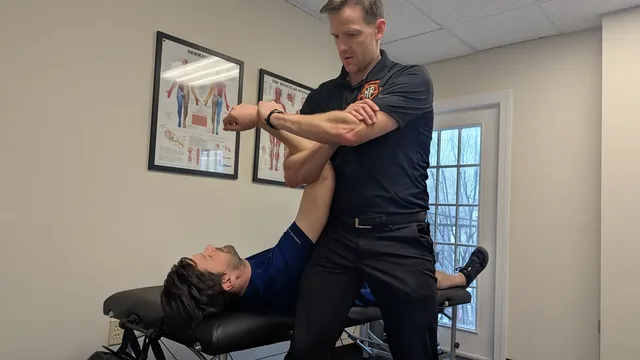
Manual therapy is the umbrella term for any hands-on technique a trained clinician uses to reduce pain and restore movement. It includes joint mobilization, soft tissue work, Active Release Technique, and myofascial release. It is a category rather than a single treatment, which is why the specific method varies by patient.
If a physical therapist or chiropractor has told you that you need manual therapy, you may have nodded along without being sure what was just described. That is fair, because manual therapy is not a single technique. It is a category, the umbrella term for every hands-on method a trained clinician uses to reduce pain and restore movement. Whether you are a cyclist with a locked-up mid back or a grandparent whose shoulder no longer reaches the top shelf, it is probably part of the conversation.
Patients at Helms Performance in Bethesda, MD usually ask me the same follow-up question: "so is that just a massage?" The short answer is no, though the two overlap. In a typical forty-minute visit I might use three or four different manual therapy techniques on the same person, each doing a different job.
Manual therapy is any hands-on treatment a clinician uses to change how a joint or a muscle moves, chosen deliberately based on what your exam showed.
What Is Manual Therapy?
Manual therapy means skilled hands-on treatment applied to joints, muscles, and the connective tissue between them. Two things separate it from a good massage.
The first is the exam that comes before it. A manual therapy session starts with finding out which joint is not moving well, which muscle is guarding, and which of those is actually driving your symptoms. The technique is chosen after that, not before.
The second is the goal. Massage aims to relax tissue and calm the nervous system, and it does that beautifully. Manual therapy aims to change a specific mechanical problem: a joint that has lost its glide, a muscle that is not letting a limb reach, a nerve that is not sliding freely through the tissue around it.
You will also see the phrase "manual physical therapy." That is the same thing, applied within a physical therapy plan of care, usually paired with exercise in the same visit.
The Main Manual Therapy Techniques Explained
Here is what actually sits under the umbrella. Each technique gets a plain-English description, because the names on their own tell you almost nothing.
- Joint mobilization. Slow, controlled pressure applied to a stiff joint, taken to the edge of its range and held or gently repeated. Nothing pops. It restores the small gliding motions a joint needs before it can move through its full arc.
- Joint manipulation, also called an adjustment. A quick, low-force thrust at a specific joint, often with an audible pop. The pop is gas releasing in the joint fluid, not anything moving out of place. It can quickly reduce pain and improve motion in a segment that is not moving.
- Soft tissue mobilization. Hands-on pressure and stripping along a muscle to reduce tension and improve how the tissue slides. This is the technique closest to what most people picture as deep massage.
- Myofascial release. Sustained, patient pressure held on one restricted spot in the fascia, the thin connective tissue wrapping every muscle, until the tissue gives way. We wrote a full guide to myofascial release if you want the longer version.
- Active Release Technique. A massage and movement-based technique that treats problems with muscles, tendons, ligaments, fascia, and nerves. The clinician holds pressure on the tissue while you actively move the limb through its range.
- Instrument-assisted soft tissue mobilization, often called Graston. A smooth-edged tool used to glide over tight or scarred tissue, which lets the clinician feel restrictions more precisely than fingers alone. Our comparison of ART and Graston covers when each one fits.
- Muscle energy technique. You gently push against the clinician's resistance, then relax, and the joint moves a little further. It uses your own muscle contraction to unlock more range.
- Manual traction. A gentle, sustained pull applied by hand to the neck or lower back to create space at an irritated segment and take pressure off a nerve.
Most visits use a combination. A stiff mid back might get mobilization, then soft tissue work on the muscles around it, then a movement drill so the new range has a reason to stay.
When Manual Therapy Makes Sense vs. Other Approaches
Manual therapy is a strong fit when the problem is mechanical. Something is stiff, something is guarding, and movement is limited because of it. Neck pain that will not turn one direction. A shoulder that catches on the way overhead. A lower back that locks after sitting.
It is a weaker fit on its own for a few situations. Pain driven mostly by load and capacity, where the tissue is simply being asked to do more than it is currently built for, responds better to a graded strength plan. Pain with heavy nerve involvement often needs a specific movement approach alongside the hands-on work. And an acutely inflamed joint may need to settle before anyone works on it directly.
The honest framing is this: manual therapy opens a window. It reduces pain and gives you more room to move, usually right away in the visit. What you do with that window determines whether the change holds.
Hands-on work creates the range. Exercise is what keeps it. A plan built on only one of the two tends to stall.
What to Expect at Your First Manual Therapy Visit
If you have never had hands-on care before, here is how a first visit usually runs.
- The conversation. When the problem started, what makes it better or worse, what you have already tried, and what you are trying to get back to. This narrows things down more than people expect.
- The movement exam. We watch you bend, reach, squat, and rotate, then test specific joints and muscles by hand to find where motion actually runs out.
- The hands-on work. Two or three techniques chosen from what the exam showed. You stay clothed in something you can move in. Nothing happens without a heads-up first.
- Movement in the same visit. Right after the hands-on portion, we load the new range with a few simple movements so your body registers it.
- Your plan. You leave with a short home program, a realistic timeline, and a clear idea of what would tell us to change course.
The practical details
- How long
- One hour, one-on-one with Dr. Helms.
- What it costs
- $165, a flat fee for the visit.
- Insurance
- We do not accept insurance directly. You can pay with an HSA or FSA card, and we will give you a superbill, an itemized receipt you can submit to your insurer for reimbursement.
Most sessions run forty to sixty minutes. Mild soreness for a day afterward is common and normal, similar to how you feel after a solid workout.
Manual Therapy at Helms Performance
Dr. Paul Helms is a sports chiropractor and physical therapist in Bethesda, MD, with advanced training in Active Release Technique. Offering both chiropractic and physical therapy under one roof means the hands-on techniques and the rehab plan come from the same exam, rather than from two providers working separately.
He has worked with patients across the full range, from people easing back into walking after surgery to athletes competing at the professional level, and the approach is the same for everyone: find the real source, treat it directly, then rebuild the strength that keeps it from coming back. You can read more about our manual therapy services in Bethesda, MD.
Dr. Paul's Final Thoughts
Manual therapy is not one magic technique, and anyone who sells it that way is overselling. It is a well-stocked toolbox, and the value comes from choosing the right tool for what your exam actually showed.
If someone has recommended manual therapy to you, it is a reasonable next step. Ask which technique they have in mind and why. A good clinician will be happy to explain it in plain English. Whether you are training for a marathon or chasing a toddler around the house, we will help you get back to work, back in the game, and back to the activities you love.