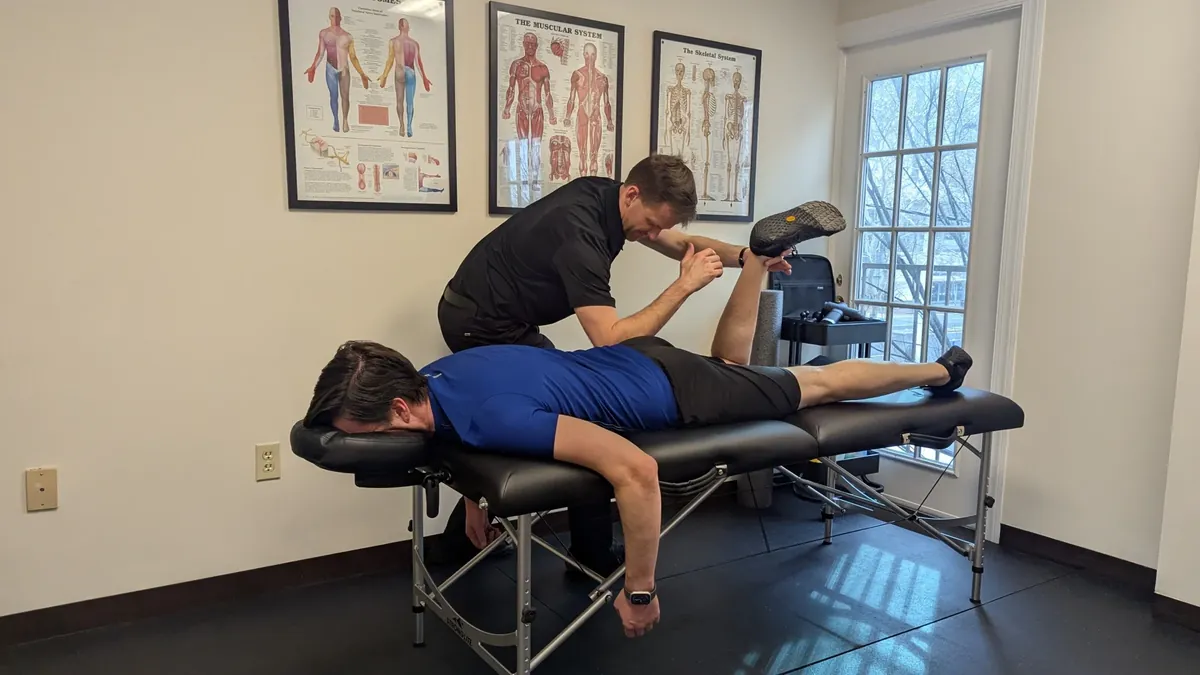
Myofascial release is a hands-on therapy that treats fascia, the thin web of connective tissue wrapping every muscle, bone, and nerve in your body. The clinician applies slow, sustained pressure to a restricted area and holds it until the tissue releases. It is used for chronic tightness, pain, and limited range of motion.
Maybe you're a runner whose hip never fully loosens up between long runs. Maybe you're a desk worker whose neck feels stiff by Wednesday no matter how much you stretch. The hands-on technique that often helps both is called myofascial release, and it works on a tissue most patients have never heard of. Whether you're chasing a personal best or just trying to bend down to tie your shoes without wincing, here is a plain-English guide to what myofascial release is, what it treats, and what to expect at Helms Performance in Bethesda, MD.
What Is Myofascial Release?
Myofascial release is a hands-on therapy that targets a tissue called fascia. Fascia is a thin, web-like layer of connective tissue that wraps every muscle, bone, organ, and nerve in your body. Think of it like the white film you see when you peel an orange, only spread throughout the entire body in one continuous sheet.
When you move freely, fascia glides smoothly. When it gets tight, sticky, or scarred from injury or repetitive use, everything around it can feel restricted. A tight band of fascia in your calf can pull on your hamstring. A restriction in your hip can change the way you walk. The pain often shows up far from the spot that actually started it.
In my practice at Helms Performance, the most common myofascial release case is a patient who has tried stretching, foam rolling, and even massage with only short-term relief. The fascia keeps tightening back up because nothing has addressed it directly. Myofascial release applies sustained, slow pressure to the restricted tissue until the fascia softens and lets go. The change tends to last longer because it modifies the tissue itself, not just the muscle on top of it.
Myofascial release is slow, sustained pressure that softens tight fascia so the muscle and joint underneath can finally move the way they should.
What Conditions It Addresses
Myofascial release is most useful when pain stays in one general area, stretching offers only short-term relief, or movement feels mysteriously restricted even after a workout warmup. Some of the situations we see it help with most often:
- Chronic low back tightness that returns after every adjustment or massage
- Hip flexor restriction in runners, cyclists, and people who sit all day
- Neck and upper shoulder tension that radiates into headaches
- Plantar fasciitis where the calf and lower leg are the actual source
- IT band pain that doesn't respond to foam rolling
- Frozen shoulder and post-surgical scar tissue
- Generalized stiffness in the postpartum body or in someone returning to activity after a long break
Myofascial release is rarely the only tool for a problem. We usually pair it with movement work, hands-on joint care, or dry needling so the relief lasts. The fascia softens, and then the surrounding muscles and joints need to learn to move differently so the restriction does not return.
What a Session Feels Like at Helms Performance
A myofascial release session begins with a quick conversation and a hands-on exam. Dr. Paul Helms wants to understand where you feel the restriction, what activities make it worse, and what you have already tried. He then watches you move so he can see how the restriction shows up in real motion, not just on a table.
The treatment itself is slower than you might expect. Most massage and even most chiropractic care moves quickly from spot to spot. Myofascial release does the opposite. Dr. Helms finds a restricted area and holds steady pressure there for 90 seconds to two minutes while the fascia gradually softens. You may feel a warm spreading sensation, a small wave of release, or a gentle pull as the tissue lets go.
You stay in comfortable clothing during most sessions. Some treatment is done through clothing, some on bare skin with the same drape coverage you would expect from any clinical massage. You will often be asked to take a deep breath or move a limb slowly while pressure is held nearby. That movement helps the fascia release more completely.
Most people feel an immediate change in range of motion or a sense of lightness after treatment. Some feel sore the next day, the way you feel after a deep tissue session. Both responses are normal.
Myofascial Release vs. Massage, The Key Difference
This question comes up often, especially from patients who have only had relaxation massage in the past. The short answer is that they overlap, but the goals and the pacing are different.
- GoalRestore movement in restricted fascia
- PacingSlow, sustained pressure held 90 seconds or longer in one spot
- Best forStubborn restrictions that keep coming back
- Where the change lastsThe fascia itself adapts, so relief tends to hold
- GoalRelax muscle and calm the nervous system
- PacingContinuous, flowing strokes across larger areas
- Best forRecovery, stress relief, general muscle tension
- Where the change lastsFeels great right away, often shorter-lived for chronic issues
The biggest practical difference is time on a single spot. A massage therapist might rub your tight hip flexor for 30 seconds and move on. A myofascial release session might stay on that same spot for two full minutes while the fascia reorganizes underneath. If you want a side-by-side breakdown of when each one fits, we wrote a separate guide on myofascial release vs. massage.
Final Thoughts from Dr. Helms
If you have been chasing the same restriction with stretching, foam rolling, or massage and getting only short-term relief, myofascial release is worth a conversation. It is not magic and it is not the right fit for every problem. But for the patient who keeps thinking "why does my hip keep getting tight again, no matter what I do," the fascia is often the answer.
Whether you are a marathon runner whose calves never quite loosen up or a grandparent whose shoulder feels stiffer every morning, an honest exam at Helms Performance in Bethesda, MD can tell you whether myofascial release is the right tool. If it is, we will explain why. If something else fits better, we will point you there too.