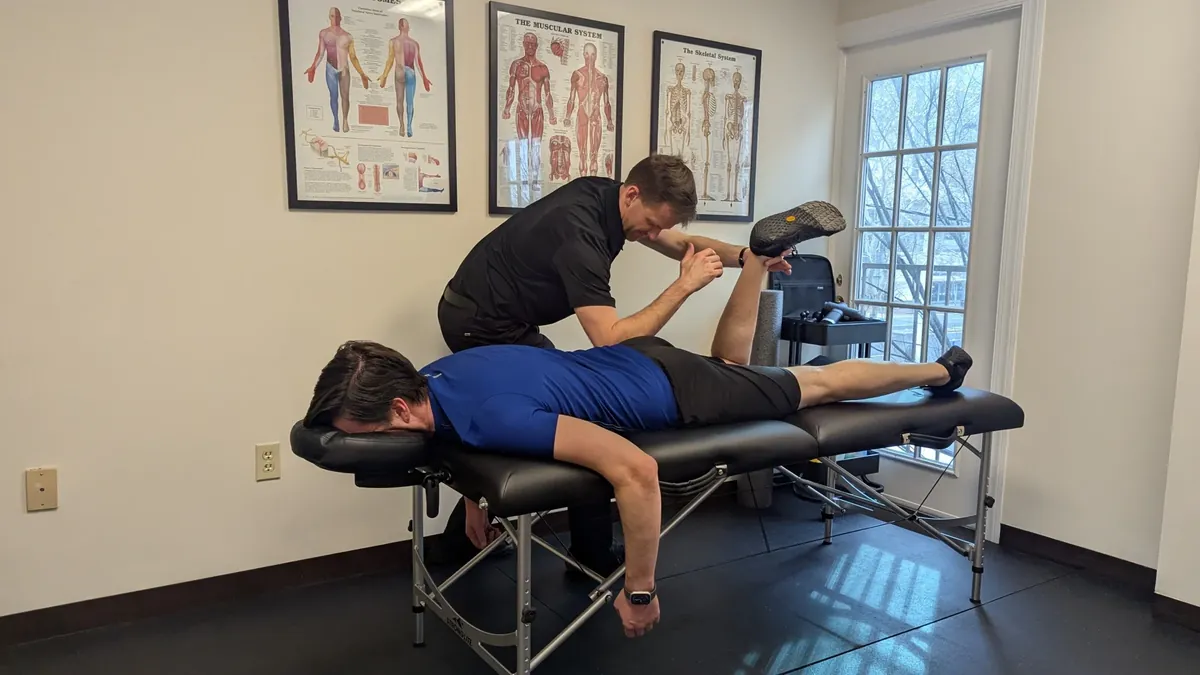
Myofascial release and massage both involve hands-on work, but they target different tissue at different speeds. Massage works mainly on muscle to ease tension and support relaxation. Myofascial release applies slow, sustained pressure to fascia, the connective tissue wrapping every muscle, and holds it until the restriction releases.
Maybe a friend swears massage finally calmed their stiff hip. Maybe your physical therapist recommended myofascial release for the same problem. Both involve hands on the body, both can feel similar on the table, and patients often use the words interchangeably. They are not the same thing. Whether you are a runner with a stubborn calf or a parent whose neck tightens up by Wednesday at the desk, here is a plain-English guide to how myofascial release and massage differ, and how to pick the one that fits.
The Short Answer
Massage therapy and myofascial release both involve hands-on work, but they aim at different things and they move at very different speeds.
- Massage therapy targets muscle and the nervous system. The goal is to relax tense muscle, calm the body, and improve circulation.
- Myofascial release targets fascia, the thin connective tissue that wraps every muscle. The goal is to restore movement in the tissue itself so the restriction does not keep coming back.
Massage works on the muscle. Myofascial release works on the wrapper around the muscle.
What Massage Is For
Most massage falls into one of three buckets: relaxation, deep tissue, or sports massage. They use different pressure and pacing, but they share the same fundamental approach. The therapist moves smoothly across muscle tissue using a mix of strokes, kneading, and friction to ease tension and improve circulation.
Massage works well for general stress relief, post-workout soreness, mild muscle tightness, and improving recovery between training sessions. It often feels wonderful right away. The effect on chronic restriction is usually shorter-lived because the touch does not stay in one spot long enough to actually change the fascia underneath.
If you are a weekend runner who wants to feel reset between long runs, or a desk worker who carries general tension in the shoulders, a good massage is hard to beat. It does what it does very well.
What Myofascial Release Is For
Myofascial release uses much slower pressure held for a longer time in one place. Instead of moving across the body, the therapist finds a restricted area and stays there. Pressure builds slowly, holds for 90 seconds to two minutes, and lets the fascia gradually let go.
This approach is better when a restriction keeps coming back no matter what you do. A tight hip flexor that will not loosen up. A calf that pulls every time you run. A shoulder that hurts on the same movement for months. The fascia, not the muscle, is often what is holding the pattern in place. Myofascial release goes directly after that tissue, which is why we wrote a full guide to what myofascial release is if you want the longer explanation.
Myofascial Release vs. Massage, Side by Side
- TargetFascia, the connective tissue around muscle
- PacingSustained pressure on one spot for 90 seconds or more
- GoalChange the tissue itself so restriction does not return
- Best forChronic restrictions that come back, specific stubborn pain
- How it feelsSlow, achy, patient. Mild soreness the next day is common
- TargetMuscle tissue and the nervous system
- PacingContinuous, flowing strokes across larger areas
- GoalRelax tense muscle and improve circulation
- Best forStress, general tension, recovery, post-workout soreness
- How it feelsFlowing, often relaxing during and immediately after
Notice the hands feel similar, but the intent behind them is different. Massage glides across the muscle. Myofascial release waits on the fascia.
Which One Should You Choose?
It comes down to what you are trying to solve.
- If you are stressed, sore from a hard workout, or want to feel relaxed for an hour, massage is a wonderful choice.
- If you have a specific restriction that keeps coming back, or pain that does not respond to stretching and foam rolling, myofascial release is the more direct path.
- Whether you are training for a half marathon or just trying to garden without your hip locking up, the question is which tissue is actually holding the problem in place.
Want to feel relaxed and reset? Get a massage. Have a specific restriction that keeps coming back? Try myofascial release.
Can You Do Both?
Yes. They complement each other nicely. Massage and myofascial release work on different layers of tissue, and many patients use both at different times for different reasons. You might see a massage therapist monthly for recovery and overall well-being, and come to us for myofascial release when a specific muscle is holding you back.
At Helms Performance, myofascial release is rarely the whole plan on its own. We pair it with hands-on joint care, movement work, and sometimes dry needling so the relief lasts. The fascia softens. The rest of the plan helps keep it that way.
What Myofascial Release Looks Like at Helms Performance
Dr. Paul Helms is a sports chiropractor and physical therapist in Bethesda, MD, with advanced training in Active Release Technique. He has worked with patients across the whole range, from people easing back into walking after an injury to professional athletes, and he treats them all with the same care and attention.
Before any myofascial release work, Dr. Helms reviews your history, watches you move, and figures out where the actual restriction is hiding. The session itself is slower than you might expect from a typical massage. He finds the restricted spot, applies steady pressure, and waits while the fascia softens. The change tends to be both more specific and longer-lasting than what most massage alone can deliver.
Dr. Paul's Final Thoughts
If you are trying to decide between a massage and a myofascial release session, the question is not which one is better. It is which one is better for the problem you are trying to solve. Massage is excellent for relaxation, recovery, and a good general reset. Myofascial release is the more direct path when a specific restriction will not loosen up.
Whether you are training for a 10K or just trying to bend down to pick up a toddler without your hip locking, an honest exam at Helms Performance in Bethesda, MD will tell you which approach fits. If it is massage, we will say so.