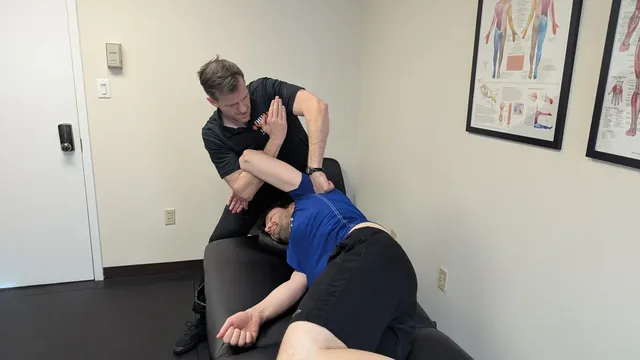
Active Release Technique and the Graston Technique both treat restricted soft tissue, but they work differently. ART uses the clinician's hands to hold a specific tissue while you move through a range of motion. Graston uses smooth stainless steel tools glided over the skin to find and treat adhesions.
If a coach or a friend has recommended the Graston Technique, and someone else swears Active Release Technique is the thing that finally helped them, it is easy to assume they are two names for the same treatment. They are not. Both ease tight, restricted soft tissue, and both can leave you a little sore the next day, but the way they work is genuinely different. Whether you are a runner chasing a stubborn calf or a parent whose shoulder aches from lifting a toddler, here is a clear, honest look at how the two compare and how Dr. Helms decides which one fits.
What the Graston Technique Is
The Graston Technique is a form of instrument-assisted soft tissue mobilization: a treatment where smooth, stainless steel tools are glided over the skin to find and ease areas of tightness, restriction, and scar tissue. Instead of hands alone, the provider uses the edge of a tool to comb through the muscle and connective tissue, a bit like ironing out a wrinkle.
The tools are good at picking up subtle changes in the tissue that are hard to feel with fingertips. When the tool passes over a restricted spot, both you and the provider can often feel a grittiness or catch. Working that area is meant to improve blood flow, soften adhesions, and help the tissue glide more freely again. Light redness or mild soreness afterward is common and usually short-lived.
Not sure which approach fits your injury? Dr. Helms will assess it and walk you through your options.
Book An ART AssessmentWhat Active Release Technique (ART) Is
Active Release Technique, often shortened to ART, is a hands-on method that treats problems with muscles, tendons, ligaments, fascia, and nerves. Rather than a tool, the provider uses their hands to apply precise tension to a specific spot while guiding the muscle through a movement. You are an active part of the treatment, which is where the name comes from.
That movement is the key difference. By combining steady contact with motion, ART targets a particular restriction, like a knot in the calf that pulls with every stride, or an adhesion in the shoulder that limits your reach. It is specific work, aimed at restoring how one structure glides against another. ART is a certified system, and Dr. Helms has completed that advanced training.
Because it works on so many tissue types, ART shows up in a wide range of everyday situations at Helms Performance. A few common ones:
- Tight hips and hamstrings that nag at runners, cyclists, and walkers
- Shoulder or elbow restrictions from lifting, throwing, or repetitive work
- Forearm and wrist tension from long hours at a keyboard
- Nerve-related symptoms, like tingling that travels down an arm or leg
- Old injuries that healed but left an area stiff or restricted
ART vs. Graston: Side by Side
Here is the simplest way to see the contrast between the two.
- ToolThe provider's hands
- How it worksTension held on a spot while you move the muscle
- StrengthPrecise, targets one restriction with motion
- Best forSpecific adhesions, nerve entrapments, sports injuries
- TrainingA certified system with advanced provider training
- ToolSmooth stainless steel instruments
- How it worksTools glide over skin to find and treat tightness
- StrengthCovers broader areas, picks up subtle changes
- Best forSurface scar tissue, larger regions of restriction
- TrainingAn instrument-assisted soft tissue system
Neither one is "better" on its own. They are different tools for different jobs. The right choice depends on where the problem is, how deep it sits, and what you are trying to get back to.
Which One Does Dr. Helms Use and Why
In my practice at Helms Performance, I reach for Active Release Technique most often. The reason is the movement. When I can hold tension on a precise spot and have you move the muscle at the same time, I get clear, specific feedback about what is restricted and whether it is releasing. For a runner's hip flexor or a desk worker's bound-up forearm, that precision tends to get results faster.
That said, the goal is always to fit the technique to the person, not the other way around. If you searched for Graston because that is the term you have heard, the honest answer is that what you likely want is skilled soft tissue care, and ART is the form of it I am certified in and rely on. You can read more about how that works on our Active Release Technique page, and if your case calls for broader hands-on work, our manual therapy options round out the plan.
Can They Be Combined?
Yes. Instrument work and hands-on work are not rivals, and many providers use elements of both. The tissue does not care which name is on the technique. It responds to skilled, specific treatment that frees up restriction and then gets paired with movement so the change lasts.
At Helms Performance, soft tissue work is rarely the whole plan on its own. We pair it with adjustments where they help, plus a few targeted exercises so the area stays loose. Techniques like ART, dry needling, and others each have their place, and you can see how a couple of them compare in our guide to dry needling vs. acupuncture.
Dr. Paul's Final Thoughts
If you came here trying to decide between the Graston Technique and ART, the most useful thing I can tell you is that the label matters less than the hands and the plan behind it. Both can help. What changes outcomes is a careful exam, the right technique for your specific restriction, and follow-up work that keeps the relief in place.
Whether you are training for a race or just want to reach the top shelf without your shoulder complaining, we are glad to take a look and talk it through. If a stubborn area of tightness has not budged with stretching or rest, soft tissue care like ART may be exactly what it needs.