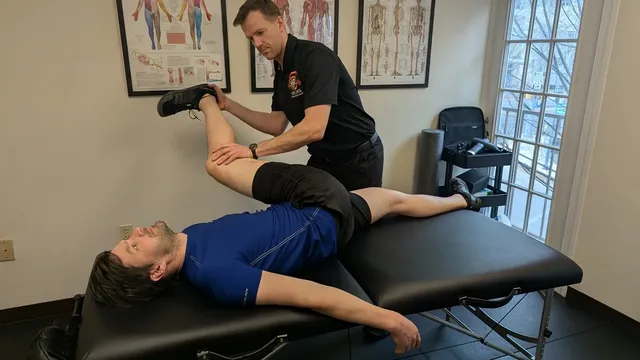
Fascial stretch therapy is a table-based, practitioner-assisted stretching method that targets fascia, the connective tissue wrapping every muscle and joint. You lie fully clothed while the clinician moves your limbs through gentle, progressive ranges of motion. It works on whole movement chains rather than stretching one muscle at a time.
Most people have never heard of fascial stretch therapy, and the ones who try it tend to walk out surprised. Whether you are a runner whose hips never quite loosen no matter how faithfully you stretch, or someone in their seventies who just wants to get out of a chair without the stiffness, FST reaches something ordinary stretching does not. Here is what it actually is, in plain English.
It is the treatment I have the hardest time explaining and the easiest time demonstrating. At Helms Performance in Bethesda, MD, most patients notice a real difference before they get off the table on their first visit, which is not something I say about many things.
Fascial stretch therapy is assisted stretching that works the connective tissue wrapping your whole body, rather than one muscle at a time.
What Is Fascial Stretch Therapy?
Fascial stretch therapy, usually shortened to FST, is a practitioner-assisted stretching method that targets your fascia. Fascia is the web of connective tissue that wraps around every muscle, joint, and organ in your body, a bit like the thin skin you find around a segment of citrus.
Here is what makes it different from stretching. You lie fully clothed on a padded table and do essentially nothing. I stabilize one part of your body and gently move another through smooth, rhythmic, traction-based movements, following the natural lines of the fascia rather than forcing against them.
Because fascia runs in continuous chains rather than in separate pieces, a restriction in your hip can quietly limit your shoulder. Working along those chains is why the release often feels deeper and holds longer than a stretch you do on your own.
It helps to know why fascia gets restricted in the first place. Connective tissue adapts to what you ask of it. Sit in the same position for years and the tissue around your hips gradually shortens to match. Recover from an injury and the tissue that laid down during healing is often stiffer and less organized than what it replaced. Neither of those changes is a muscle problem, which is exactly why stretching the muscle keeps missing.
How It Differs from a Regular Stretch or Massage
The three get lumped together constantly. They are genuinely different things.
- TargetsThe whole fascial system and the joint capsule
- MethodAssisted traction through multiple planes of motion
- Your jobNothing. You stay relaxed while the movement is guided
- Best forChronic tightness that stretching never resolves
- TargetsOne muscle at a time, or muscle tissue broadly
- MethodA fixed hold, or pressure applied across the muscle
- Your jobHolding position yourself, or lying still
- Best forGeneral flexibility, recovery, and relaxation
A static hamstring stretch pulls on one muscle in one direction. A massage works pressure across the muscle. FST moves your joint through its available range while applying gentle traction, which reaches the tissue around and between structures rather than the muscle belly alone.
People also ask how FST compares to myofascial release. Both work on fascia. Myofascial release holds steady pressure on one restricted spot until it gives way. FST keeps you moving and works along the whole chain. They pair well, and I use both depending on what the exam shows.
What Conditions It Helps
FST is a good fit more often than people expect. The common thread is tissue that feels restricted rather than injured.
- Chronic tightness that stretching never fixes. If you stretch regularly and never feel looser, the restriction is usually in the fascia rather than the muscle. This is the single most common reason patients try FST.
- Runners and cyclists. Tight hips, hamstrings, and calves build up over the miles. Working the whole lower-body chain tends to help more than chasing each muscle individually.
- Desk workers. Hours of sitting compress the hips and load the neck and shoulders. FST relieves the tension that builds from holding one position all day.
- Older adults. Range of motion matters more with every decade. FST helps you keep reaching, bending, and moving comfortably through ordinary daily life.
- Anyone maintaining gains after treatment. Once a course of chiropractic or physical therapy has done its job, FST is a good way to keep the mobility you worked for.
It is not the right first step for an acute injury, a fresh strain, or pain that came on suddenly with swelling. Those need an exam first.
The benefit patients report most often is not dramatic. It is that ordinary movements stop announcing themselves. Getting out of the car, reaching into a back seat, rolling over in bed. When those go quiet, you tend to notice how loud they had become.
What a Session Looks Like at Helms Performance
Your first visit is both an assessment and a treatment. Here is the shape of it.
- The conversation. What feels restricted, what you have tried, and what you are trying to get back to doing comfortably.
- The movement screen. I check how your joints actually move and where the range runs out, so the session targets your restrictions rather than a generic routine.
- The table work. You lie fully clothed on a padded table. I stabilize one segment and guide another through slow, rhythmic traction along the fascial lines. Your only job is to breathe and stay relaxed.
- The reassessment. We recheck the same movements from the screen so you can feel the difference rather than take my word for it.
- Your plan. You leave with a clear picture of what is restricting you and what will help it hold.
Wear comfortable, form-fitting athletic clothing such as leggings, shorts, or yoga pants. You stay fully clothed the whole time, but loose fabric makes it harder to feel the fascial tension and guide the movement accurately. Leave the jeans at home.
FST also works naturally alongside our other hands-on services in Bethesda, MD. It is often the piece that keeps chiropractic and physical therapy gains from slipping away between visits.
Final Thoughts from Dr. Helms
Few practices around Bethesda offer fascial stretch therapy, which is why most people meet it for the first time in our office. That is a shame, because it answers a complaint I hear constantly: "I stretch all the time and I am still tight."
If that sounds familiar, the problem is probably not your discipline. It is that the restriction lives in tissue you cannot reach on your own. Whether you are training for a spring race or simply want to reach the top shelf without your shoulder complaining, we will help you get back to work, back in the game, and back to the activities you love.