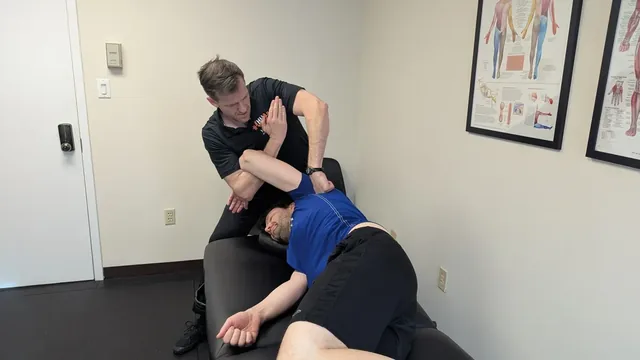
Active Release Technique is a hands-on soft tissue treatment where a certified provider holds precise pressure on a restricted spot in a muscle, tendon, ligament, fascia, or nerve while you move that body part through its full range of motion. That patient movement is what separates Active Release Technique, often shortened to ART, from a massage.
Maybe your heel is sore for the first ten minutes of every morning. Maybe the outside of your knee starts talking to you at mile four. Whether you are building toward a fall half marathon or just want to carry laundry upstairs without your hip catching, the frustrating part is the same. You rested. You stretched. It came back anyway. ART is built for exactly that situation, and here is a plain-English look at how it works.
What Is Active Release Technique and How Does It Work?
Active Release Technique treats adhesions. An adhesion is a patch of dense, sticky scar tissue that forms inside soft tissue after overuse, injury, or the same movement repeated a few thousand times. Healthy muscle glides. Tissue with an adhesion in it drags, and that drag shows up as tightness, weakness, or pain that does not track with how much you rested.
In my practice at Helms Performance, the pattern I see most often is a patient who has stretched a sore calf every day for two months with no change. Stretching pulls on the whole muscle. It cannot reach a coin-sized adhesion sitting deep in one part of it. ART can, because the pressure is placed on that one spot and held there while the tissue slides underneath it.
Here is the sequence in a single ART pass:
- Step 1. Find the restriction. Dr. Helms moves through the tissue by hand until he locates the spot that feels dense and does not glide. It is often not where you feel the pain.
- Step 2. Hold pressure on it. A specific, sustained contact goes on that spot and stays there.
- Step 3. You move. You take the limb through a guided range of motion while the pressure holds, so the restricted tissue is drawn underneath the contact.
- Step 4. Recheck. The same movement is retested to see how much glide came back before moving on.
A massage works on a muscle. Active Release Technique works on one restricted spot inside that muscle, while you move it.
How Is Active Release Technique Different From Massage?
Both are hands-on. Both feel good afterward. The difference is who is doing the work during the treatment, and how narrow the target is. If you are also weighing instrument-based work, we compared Active Release Technique and Graston in a separate guide.
| Active Release Technique | Therapeutic Massage | |
|---|---|---|
| What you do | Move the limb through a range of motion | Stay still and relaxed |
| Target | One specific adhesion | A broad area of muscle |
| Tissues treated | Muscle, tendon, ligament, fascia, and nerve | Mainly muscle and fascia |
| Provider training | Certification in a set of named protocols | Massage or manual therapy training |
| Typical course | 2 to 6 visits for most conditions | Often ongoing for maintenance |
Neither one is better. They answer different questions. If a specific spot keeps flaring, ART is the more precise tool. If your whole back is carrying a hard month, a therapeutic massage may serve you better.
What Does an Active Release Technique Session Feel Like?
At Helms Performance a visit is one hour, one-on-one with Dr. Helms. It opens with questions and a movement check. Where does it hurt, what makes it worse, and what are you trying to get back to?
Then the hands-on work starts. You will feel firm, deep contact on one point, and as you move the limb you often feel something give way underneath the pressure. Patients describe it as a strong ache while it happens and a distinct sense of release right after. It is not subtle, and it does not last long. Each pass takes seconds, not minutes.
Most people can feel a change in range of motion before they leave the table. Mild soreness the next day is normal and usually clears within 24 to 48 hours.
What Conditions Does Active Release Technique Treat?
ART is certified across more than 500 named protocols, which is a formal way of saying most muscles, tendons, and nerve pathways in the body have a specific treatment sequence. The problems it comes up for most often here:
- Plantar fasciitis driven by restriction in the calf and the sole of the foot.
- IT band and lateral knee pain in runners and cyclists.
- Tennis and golfer's elbow, where forearm tendons have thickened from repetitive load.
- Shoulder impingement and rotator cuff tightness that limits overhead reach.
- Sciatic symptoms when a tight piriformis or deep hip rotator is irritating the nerve along its path.
- Neck tension and headaches referred from the neck.
- Hip flexor tightness from long hours of sitting.
Our full Active Release Technique page walks through each of these in more detail, including what a treatment plan usually looks like for each one.
Who Is Active Release Technique For?
Wider group than the name suggests. The word active describes what you do on the table, not the kind of person who qualifies.
- Runners, lifters, and weekend athletes with a recurring overuse spot.
- Desk workers whose neck, upper back, and forearms tighten by Wednesday.
- Adults in their 60s, 70s, and beyond with long-standing stiffness that has slowly narrowed what they do.
- New parents carrying a lot of asymmetric load right now.
- Anyone cleared after an injury or surgery whose scar tissue is now the limiting factor.
A 71-year-old who wants to walk the Capital Crescent Trail without her hip catching gets the same hour and the same protocols as a CrossFit athlete with an angry shoulder. Dr. Helms has worked with patients across that whole range, including professional athletes in the NFL and NBA, and treats the range as a credential for everyone rather than a filter.
When Is Active Release Technique Not the Right Answer?
There are times to get evaluated before you book any hands-on treatment. If your pain came on suddenly, followed a fall or a crash, comes with numbness, weakness, or changes in bowel or bladder function, or has not improved at all in weeks, that needs a proper exam first. ART treats soft tissue restriction. It is not a diagnosis, and a few problems that feel like tight muscle are not tight muscle.
ART is also usually held off on freshly inflamed tissue, open wounds, or an area that is still in the acute stage of a strain. In those cases we start somewhere gentler and bring ART in once the tissue is ready.
How Much Does Active Release Technique Cost in Bethesda, MD?
A visit at Helms Performance is a flat $165 for the full hour with Dr. Helms. We do not bill insurance directly. You can pay with an HSA or FSA card, and we provide a superbill, which is an itemized receipt with treatment codes that you can submit to your insurer for possible reimbursement. Coverage varies widely by plan, so check yours before assuming either way.
No referral is needed, and same-day appointments are often available. Dr. Helms is a sports chiropractor certified in Active Release Technique and Fascial Stretch Therapy, and he often pairs ART with sports chiropractic care in the same hour when the joint and the soft tissue are both part of the picture.
Final Thoughts from Dr. Helms
If you remember one thing from this, make it the reason the movement matters. Pressure alone can loosen a muscle for an afternoon. Pressure plus movement is what restores the glide between tissues, and that is what makes the relief hold past the weekend.
Whether you are chasing a personal record or simply want to get through a workday without reaching for the heating pad, an honest exam at Helms Performance in Bethesda, MD will tell you whether an adhesion is really what is driving your problem. If it is not, we will say so and point you at what will help.