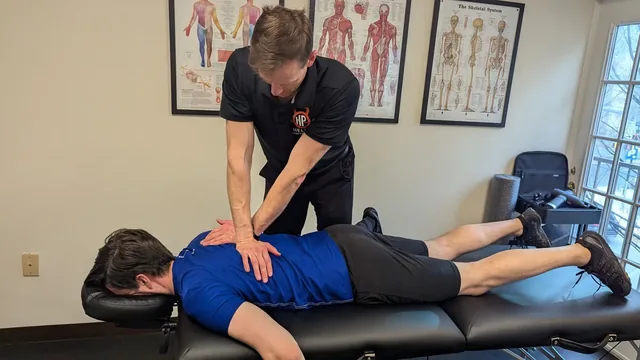
Self myofascial release is what you are doing when you roll a tight muscle over a foam roller or a lacrosse ball. It genuinely helps between visits by easing tension and improving short-term mobility. What it cannot do is resolve a restriction that has been building for months, which is where hands-on treatment comes in.
Every time you roll a tight calf over a foam roller or park a lacrosse ball under a stubborn glute, you are doing self myofascial release. Whether you are a runner whose hamstrings tighten up after a long weekend effort, or someone whose lower back stiffens after eight hours at a desk, these tools are genuinely useful. They are also widely oversold. Here is an honest look at what works at home, what does not, and how to tell when it is time to get help.
In my practice at Helms Performance in Bethesda, MD, most patients who come in for a stubborn tight spot have already tried foam rolling it. That tells you two things at once. These tools are popular for a good reason, and they have a ceiling.
Self myofascial release is a good way to manage tension between visits. It is not a reliable way to resolve a restriction that keeps coming back.
Self Myofascial Release Tools That Actually Work
You do not need a closet full of gear. Three tools cover almost everything, and each one has a job it does better than the others.
- Foam roller. Best for large muscle groups: quads, hamstrings, calves, and the upper back. The broad surface spreads pressure out, which makes it forgiving and hard to overdo.
- Lacrosse ball or massage ball. Best for small, specific spots: glutes, the muscles around the shoulder blade, chest, and the bottom of the foot. A ball reaches places a roller simply cannot.
- Massage gun. Best for a quick warm-up before activity, or for a spot you cannot get pressure into any other way. Fast and convenient, but shallow compared to a held press.
A few things people do that tend not to help. Rolling directly over the IT band on the side of the thigh is mostly uncomfortable without changing much, because that band is dense connective tissue and does not lengthen from pressure. Rolling your low back over the roller puts pressure on the spine rather than muscle. And rolling an area that is freshly swollen or sharply painful usually makes the guarding worse, not better.
One honest note on how this works. The change you feel afterward is probably less about physically reshaping the fascia and more about your nervous system turning down its protective guarding in that area. That is still a real effect, and it is still worth doing. It just explains why the looseness often fades by the next morning.
How to Use Them Without Making Things Worse
Most people roll too fast, too hard, and over too much territory. Here is the approach I give patients.
- Find the spot, not the whole muscle. Roll slowly until you land on the one place that feels different. That is your target. Stop there.
- Hold, do not saw. Rest steady pressure on that spot for 60 to 90 seconds. Rapid back-and-forth rolling never stays anywhere long enough to matter.
- Keep it at a 4 or 5 out of 10. It should feel like productive pressure, not something you need to brace against. If you are holding your breath, back off.
- Breathe slowly the whole time. This sounds soft. It is not. Slow breathing is what lets the muscle stop guarding against the pressure.
- Move right afterward. Ten squats, a few lunges, a short walk. Movement is what tells your body to keep the range you just gained.
Avoid rolling directly over bone, over a joint, or over the places where nerves sit close to the surface: behind the knee, the inside of the elbow, and the front crease of the hip. If you feel tingling, burning, or anything shooting down a limb, move off that spot.
What Self-Release Can't Address (and Why It Matters)
Here is where the honest part comes in. A roller is a blunt tool applied by someone who cannot see what they are working on. There are four things it cannot do.
- It cannot find the actual source. The spot that hurts is often not the spot causing the problem. Tight calves are frequently a hip issue. A sore upper back is frequently a mid-back mobility issue. Rolling the sore spot treats the symptom.
- It cannot reach a joint restriction. If a joint has lost its normal glide, no amount of soft tissue pressure around it will restore that. That needs hands-on manual therapy or an adjustment.
- It cannot sustain a real myofascial release. Clinical myofascial release means steady, specific pressure held while the tissue gradually gives way, with the practitioner adjusting angle and depth by feel. You cannot replicate that on yourself, because you cannot fully relax against your own body weight.
- It cannot rule anything out. A roller has no way of telling you that your "tight hamstring" is actually nerve tension from your lower back.
That last one matters most. Self-release is safe for ordinary muscular tightness. It is not a substitute for figuring out what is going on.
When to Stop DIY and See a Professional
Rolling a tight spot for a week is reasonable. Rolling the same spot for three months is a message. Here is when to stop working on it alone.
- The same spot comes back within a day or two, every time, for more than three or four weeks.
- You have numbness, tingling, or pain that travels down an arm or a leg.
- The pain wakes you at night or is there before you get out of bed.
- Rolling makes it worse rather than better.
- There is visible swelling, a joint that feels unstable, or pain that followed a specific injury.
- You are avoiding an activity you care about, whether that is a 10K, a tennis league, or getting down on the floor with a grandchild.
None of these mean something is seriously wrong. They mean the problem is past what a roller can sort out on its own.
How Self-Release Fits Alongside Professional Care
Self myofascial release is not the opposite of getting treated. It works best as the maintenance layer around it.
Dr. Paul Helms is a sports chiropractor and physical therapist in Bethesda, MD, with advanced training in Active Release Technique. He works with patients across the whole range, from people easing back into walking after an injury to professional athletes, and the plan looks similar in structure for all of them. We find the actual source, treat it directly with hands-on work, and then rebuild the strength and mobility that keeps it from returning. Your roller has a place in that plan. We will usually tell you exactly which two spots to work on and which ones to leave alone.
If you are still deciding what kind of hands-on work fits your situation, our guide to myofascial release versus massage lays out the difference.
Final Thoughts from Dr. Helms
Foam rollers, balls, and massage guns are worth owning. They help you manage tension, they feel good after a hard session, and they give you something useful to do on the days between visits. Keep using them.
Just watch for the ceiling. When the same spot keeps coming back no matter how patiently you work on it, that is not a sign to roll harder. It is a sign that something upstream has not been addressed yet. Whether you are training for a spring half marathon or simply want to garden without your hip locking up, an honest exam at Helms Performance in Bethesda, MD will tell you where the problem actually lives, and we will help you get back to the activities you love.