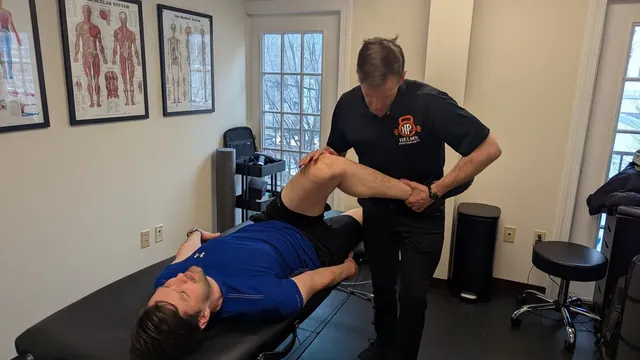
How often you should get Active Release Technique depends on the problem, but most people start with one to two sessions per week. Most patients notice meaningful improvement within 2 to 4 visits, and a full course for most conditions runs 2 to 6 visits, with sessions spaced further apart as you improve.
Whether you are trying to get a sore Achilles ready for a fall race or just want to turn your head to back out of the driveway without wincing, nobody wants an open-ended treatment plan. You want to know how many visits it will take and when you can stop coming.
In my practice at Helms Performance in Bethesda, MD, I give every patient a specific plan after the first visit, not a standing weekly appointment. Here is how I decide on that plan, and what you can expect along the way.
Start with one to two ART visits per week, expect to feel a difference within 2 to 4 visits, and space visits out as the problem settles.
How Often Should You Get Active Release Technique?
Active Release Technique, or ART, is a massage and movement-based technique that treats problems with muscles, tendons, ligaments, fascia, and nerves. I hold precise pressure on a restricted spot while you move through a specific motion, which helps that tissue glide the way it should again.
For most problems, one to two sessions per week is the right starting pace. That gives the treated tissue a day or two to settle between visits, while keeping enough momentum that the change from one session carries into the next. Mild soreness for 24 to 48 hours after a session is normal, and it is one reason I do not treat the same area every day.
How Many ART Sessions Do Most Problems Take?
The biggest factor is how long the problem has been there. A restriction from last month usually clears faster than one that has built up over years. Here is a general guide based on what I see in practice. Your own plan will depend on your exam.
| Situation | Starting frequency | Typical course |
|---|---|---|
| Recent tightness or strain (a few weeks old) | 1 to 2 visits per week | 1 to 3 visits |
| Recurring overuse problem (runner's knee, tennis elbow, desk neck) | 1 to 2 visits per week | 2 to 6 visits |
| Long-standing stiffness (months to years, or an old injury) | 1 to 2 visits per week, then weekly | The longer end of 2 to 6, sometimes more |
| After you feel better | Optional check-ins | Only if you want them |
These ranges are typical, not a promise. If a problem is not responding the way it should, we change the plan instead of adding more of the same visits.
How Long Does Active Release Technique Take to Work?
Many patients feel a change in range of motion before they leave the first visit. A shoulder reaches a little higher, or a hip lets you sit cross-legged a little easier. That first change is a useful sign, but it is not the finish line.
Lasting relief usually builds over the first 2 to 4 visits, as the tissue holds more of its new range between sessions. A good sign is when you notice the problem less during daily life, like the stairs at work or the first mile of a run, not just on the treatment table.
If you want a closer look at what happens during each session, our guide on what Active Release Technique is walks through it step by step.
What Changes How Many Visits You Need?
- How long the problem has been around. Tissue that has been restricted for years takes more visits to change than tissue that tightened up last month.
- Whether the cause is still there. If the same running form, desk setup, or lifting habit keeps loading the area, we address that too, or the problem tends to come back.
- Your home exercises. ART helps the tissue move. A few targeted exercises between visits help it stay that way, and patients who do them usually need fewer sessions.
- What else is involved. If a stiff joint or an irritated nerve is part of the picture, I may pair ART with an adjustment or physical therapy in the same visit.
When Should You Space Out or Stop ART Visits?
As the problem settles, visits move from twice a week to once a week, then to every couple of weeks. Once you are back to what you want to do, you can stop. Some active patients like an occasional check-in during a heavy training block, and some never come back for that area again. Both are fine.
It also works the other way. If an area has not changed after 3 or 4 visits, more ART is not the answer. That is a signal to look again, because the problem may be coming from somewhere else, or it may need a different approach entirely.
At Helms Performance, every visit is a full hour one-on-one with Dr. Helms at a flat fee of $165. Our Active Release Technique service in Bethesda, MD page covers what a full course of care includes.
Dr. Paul Helms is a sports chiropractor at Helms Performance in Bethesda, MD, with advanced certification in Active Release Technique and training in dry needling and sports physical therapy. He works with patients across the whole range, from desk workers and retirees to professional athletes in the NFL and NBA.
Dr. Paul's Final Thoughts
The right ART schedule is the one with an end date. Start with one to two visits a week, look for real change in your daily life within a few visits, and space things out as you improve.
If a provider cannot tell you roughly how many visits to expect, ask. Whether you are working toward a race or just want to sleep without your shoulder waking you up, we will help you get back to work, back in the game, and back to the activities you love.