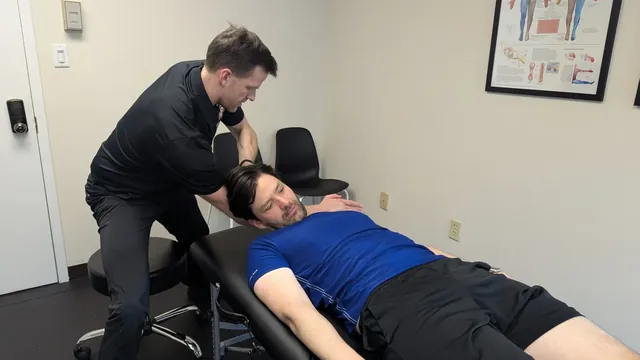
Active Release Technique for neck pain is a hands-on treatment that finds tight, stuck spots in the muscles of the neck and upper back and releases them while you move your head through a specific motion. Most patients notice their neck turning more freely within 2 to 4 visits, and a full course usually runs 2 to 6 visits.
Whether your neck locks up after a long day of video calls, tightens during heavy overhead lifts, or makes it hard to check the back seat before you pull out of the driveway, the problem is often the same. The muscles that hold your head up have been working too hard for too long, and a few of them have stopped sliding the way they should.
In my practice at Helms Performance in Bethesda, MD, most of the neck pain I see lives in the soft tissue rather than the joint. Patients often arrive expecting an adjustment, and many are surprised that the biggest change comes from freeing up the muscles that have been holding the neck stiff for months. That is the layer Active Release Technique goes after.
ART treats the tight, stuck muscle tissue that keeps a neck stiff, and it does it while you move, which is why the change tends to show up in how your neck turns, not just how it feels.
How Does Active Release Technique Help Neck Pain?
Active Release Technique, or ART, is a massage and movement-based technique that treats problems with muscles, tendons, ligaments, fascia, and nerves. The key word is active. Instead of lying still while someone rubs a sore spot, you move while the provider holds precise tension on the tissue.
Here is why that matters. When a muscle is overworked or injured, the body lays down small patches of tough, sticky tissue called adhesions. Think of them as internal scar tissue. Adhesions make one layer of muscle stick to the layer beside it, so the tissue cannot glide, shorten, or lengthen fully. In the neck, that shows up as a head that will not turn all the way, or an ache that stretching never quite reaches.
During ART, I find the adhesion with my hands, hold contact on it, and then guide you through a movement that lengthens that exact tissue. Turning or tilting your head pulls the stuck fibers under my contact and separates them, a bit like smoothing a wrinkle out of a rug by holding one edge while someone pulls the other. Each pass takes a few seconds, and the tissue usually softens within a handful of passes.
What Does ART Target in the Neck and Upper Back?
Neck pain rarely comes from one muscle. These are the tissues I check on almost every neck visit, and what each one tends to cause when it is stuck.
| Muscle | Where it is | What it causes when it is stuck |
|---|---|---|
| Upper trapezius | The shelf between your neck and shoulder | A constant ache across the top of the shoulders, worse by the end of a desk day |
| Levator scapulae | From the top of the shoulder blade up to the side of the neck | The sharp knot you feel when you turn your head, and the neck that locks up after sleeping wrong |
| Suboccipitals | Small muscles at the base of the skull | Headaches that start at the back of the head and wrap toward the eyes |
| Scalenes | The side of the neck, above the collarbone | Tightness with tingling or heaviness in the arm, since the nerves to the arm pass between them |
| Sternocleidomastoid | The rope-like muscle running from behind the ear to the collarbone | Pain at the front of the neck and a head that tilts slightly to one side |
| Pectoralis minor | Under the chest muscle, near the front of the shoulder | Rounded shoulders that pull the head forward and load the whole neck |
The last two are not neck muscles, and they are on the list on purpose. A neck that hurts is often being pulled on by tissue below it.
Which Neck Pain Patterns Respond Well to ART?
ART works best when the problem is tissue that has tightened and stuck, rather than a joint that is inflamed or a disc that is pressing on a nerve. In my experience these patterns respond well:
- Desk and screen neck. Stiffness that builds through the workday and eases on weekends. Usually the upper trapezius, levator scapulae, and pectoralis minor.
- The one-sided locked neck. You woke up and cannot turn your head to one side. Often the levator scapulae, and it tends to release quickly.
- Headaches that start at the base of the skull. Frequently the suboccipitals and upper trapezius referring pain upward.
- Tightness with tingling into the arm. When the scalenes or pectoralis minor pinch the nerves on their way to the arm, releasing the muscle can relieve the symptoms. This one always gets a careful exam first, because a disc can cause the same feeling.
- Old injury stiffness. A neck that never fully loosened after a car accident, fall, or sports collision, months or years later.
- Training neck. Tightness from overhead lifting, swimming, cycling, or any sport that keeps the head fixed in one position for a long time.
A few situations need a physician before any hands-on care: numbness or weakness in the arm that is getting worse, neck pain after a significant injury, a fever with neck stiffness, or a sudden severe headache unlike any you have had before. Please do not try to sort those out yourself. If you are unsure which category you fall into, our neck pain in Bethesda, MD page walks through the common causes.
What Should You Expect Over a Course of Treatment?
Your first visit is an evaluation and a treatment in the same hour. I check how your neck turns and tilts, where the tissue is stuck, and whether the joints or nerves are involved too. Then we start. Most people leave the first visit turning their head further than when they walked in.
ART is a deep, specific pressure, and the moment I hold tension on an adhesion while you move can feel intense for a few seconds. Patients often call it a good hurt. It eases as the tissue releases, and you are in control the whole time. Some soreness for a day or two afterward is normal. A walk or an easy jog that evening settles it faster than resting does.
Most neck conditions take 2 to 6 visits, and the majority of patients notice meaningful improvement within 2 to 4. ART is rarely the whole plan. I usually pair it with cervical adjustments, meaning gentle joint work to restore motion in the neck itself, and a few targeted exercises so the change holds between visits. Our Active Release Technique service in Bethesda, MD page covers the full approach. Every visit is a full hour at a flat fee of $165. We do not bill insurance directly, but HSA and FSA cards are welcome and we provide a superbill you can submit for reimbursement.
Dr. Paul Helms is a sports chiropractor at Helms Performance in Bethesda, MD, with advanced certification in Active Release Technique and training in dry needling and sports physical therapy. He works with patients across the whole range, from desk workers and retirees to professional athletes in the NFL and NBA.
Dr. Paul's Final Thoughts
If your neck has been stiff for months and stretching, massage, and a new pillow have not changed it, there is a good chance the problem is tissue that has stuck rather than tissue that is simply tight. Stuck tissue does not stretch loose. It has to be released.
That is what ART is for. Whether you want to get back to overhead training or just want to look over your shoulder without wincing, we will help you get back to work, back in the game, and back to the activities you love.