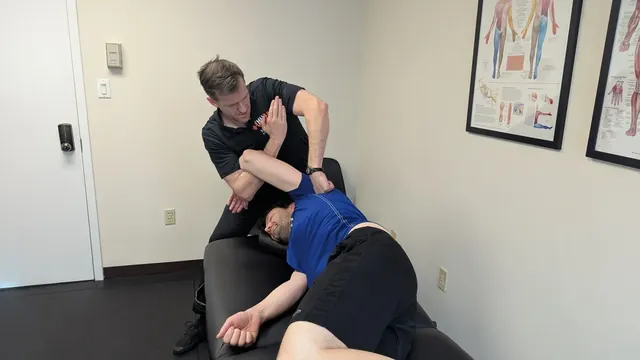
Active Release Technique does hurt a little, but only for a few seconds at a time. Most patients describe ART as a deep, strong pressure, a "good hurt" like pressing on a sore knot, that eases as the tissue releases. Mild soreness for 24 to 48 hours afterward is normal, and you can ask for lighter pressure at any point.
Whether you are a runner with a calf that keeps tightening at mile three or a grandparent whose shoulder makes it hard to reach the top shelf, the question before a first visit is usually the same. Is this going to hurt? It is a fair thing to ask, and you deserve a straight answer before you book.
In my practice at Helms Performance in Bethesda, MD, I hear some version of that question almost every week. The honest answer is that ART is not gentle, but it is brief, it is predictable, and it stays within what you can comfortably handle. Here is what to expect, moment by moment.
ART feels like a few seconds of firm, focused pressure that lets go as the tissue releases, followed by a day or two of workout-style soreness.
Does Active Release Technique Hurt, and Why?
Active Release Technique, or ART, is a massage and movement-based technique that treats problems with muscles, tendons, ligaments, fascia, and nerves. I hold precise pressure on one restricted spot while you move that body part through a specific motion.
That restricted spot is usually an adhesion: a small patch of dense, sticky tissue that forms after overuse, injury, or the same motion repeated thousands of times. Tissue with an adhesion in it is often already tender to the touch. So when the pressure lands right on it, you feel it. That discomfort comes from working on the actual problem, which is why it tends to be strongest on the spot that has been bothering you.
The key difference from most painful experiences is how short it is. Each pass of ART takes a few seconds. The pressure builds as you move, peaks briefly, and then fades as the tissue lets go.
What Does ART Feel Like During a Session?
Here is what most patients feel during a single pass, and how long each part lasts.
| Moment | What you feel | How long |
|---|---|---|
| Finding the spot | Firm pressure as I locate the tight, tender area | A few seconds |
| You move | A deep, strong ache that builds as the tissue slides under my hand | 2 to 5 seconds |
| The release | A sense of something letting go, then the ache drops off | Instant |
| The recheck | You repeat the movement and usually notice it moves more freely | Seconds |
A typical area gets several passes, so the whole treatment is a series of short, strong moments with breaks in between, not minutes of steady pain.
If you want the fuller picture of how a session is structured, our guide on what Active Release Technique is walks through it step by step.
Why Do Some Areas Feel More Intense Than Others?
Not every spot feels the same. In my experience, a few things tend to make a pass feel stronger:
- How long the problem has been there. A restriction that has built up over months or years is usually more tender at first than one from last week.
- Where it is. Areas with less padding over the tissue, like the forearm, the sole of the foot, or the side of the neck, often feel sharper than a large muscle like the glutes.
- How irritated the area is right now. Tissue that is in a flare day feels everything more. On those days we go lighter or work on the areas around it first.
The flip side is encouraging. Many patients tell me the same spot feels noticeably less intense by the second or third visit, as the tissue starts to move better.
How Do You Tell a "Good Hurt" From Pain That Means Stop?
A good hurt is a deep, dull ache that you can breathe through, that peaks for a moment, and that eases as soon as the pass ends. That is what ART should feel like.
Tell me right away if you feel any of these, and we will change what we are doing:
- Sharp, stabbing, or electric pain
- Burning, tingling, or numbness that shoots down an arm or leg
- Pain that lingers after the pass has ended instead of fading
- Any urge to hold your breath or tense up to get through it
You are in control of the pressure the entire time. I check in throughout every session, and adjusting is easy. Gritting your teeth through sharp pain does not make ART work better.
How Sore Will You Be After Active Release Technique?
Most people feel mild soreness in the treated area for 24 to 48 hours, a lot like the day after a good workout. Some people feel nothing at all. Neither one tells you whether the treatment worked. What matters is how the area moves and feels over the next week.
To settle soreness faster, move. A 20 to 30 minute walk or an easy jog the same day helps more than resting on the couch. Moderate weightlifting is fine too. Just skip a heavy personal record or max-effort lift for 24 to 48 hours. If soreness is getting worse instead of better after two days, call us so we can take a look.
At Helms Performance, every visit is a full hour one-on-one with Dr. Helms at a flat fee of $165. Our Active Release Technique service in Bethesda, MD page explains what a full course of care looks like.
Dr. Paul Helms is a sports chiropractor at Helms Performance in Bethesda, MD, with advanced certification in Active Release Technique and training in dry needling and sports physical therapy. He works with patients across the whole range, from desk workers and retirees to professional athletes in the NFL and NBA.
Final Thoughts from Dr. Helms
ART is firmer than a spa massage, and I would rather you know that going in. Each pass is a few seconds of strong pressure on the exact spot that has been bothering you, and most people find that very manageable once they know what is coming.
If you are nervous, say so at the start. We will begin lighter and build from there. Whether you want to get back to training or just want to garden without that nagging ache, we will help you get back to work, back in the game, and back to the activities you love.