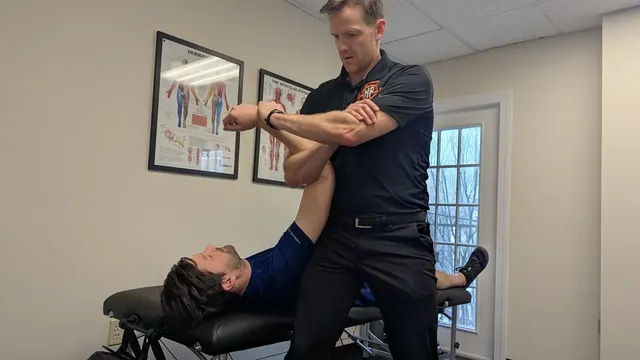
Active Release Technique for the shoulder is a hands-on treatment that releases tight, stuck spots in the rotator cuff, chest, and upper back muscles while you move your arm through a specific motion. It helps most with pinching overhead, rotator cuff tightness, and stiffness after an old injury. Most patients notice meaningful improvement within 2 to 4 visits.
Whether your shoulder pinches when you press a barbell overhead, aches when you reach for the seatbelt, or wakes you up when you roll onto that side, it changes how you move through the whole day. You start avoiding the top shelf. You stop throwing the ball for the dog.
In my practice at Helms Performance in Bethesda, MD, a lot of the shoulder pain I see comes from the muscles around the joint rather than the joint itself. Those muscles have tightened, stuck together, and stopped letting the shoulder blade and arm move the way they should. That is the layer Active Release Technique is built to treat.
ART frees up the stuck muscle tissue that keeps a shoulder from moving freely, and because you move during treatment, the change usually shows up in how high and how comfortably you can reach.
How Does Active Release Technique Help Shoulder Pain?
Active Release Technique, or ART, is a massage and movement-based technique that treats problems with muscles, tendons, ligaments, fascia, and nerves. I find a restricted spot with my hands, hold precise pressure on it, and then guide your arm through a movement that lengthens that exact tissue.
The restriction is usually an adhesion: a small patch of dense, sticky tissue that forms after overuse, injury, or the same motion repeated thousands of times. In the shoulder, adhesions keep muscles from gliding past each other. The result is a shoulder that feels tight, pinches at a certain point in the motion, or loses strength because the muscles cannot work through their full range.
Each pass takes a few seconds. As you move your arm, the stuck tissue slides under my contact and loosens. Most people can feel a difference in their reach before they leave the table.
Which Shoulder Muscles Does ART Target?
The shoulder is the most mobile joint in the body, which means it depends on a lot of muscles working together. These are the ones I check on almost every shoulder visit.
| Muscle | Where it is | What you notice when it is stuck |
|---|---|---|
| Supraspinatus | Top of the shoulder blade | Pain lifting your arm out to the side, often in the middle of the motion |
| Infraspinatus and teres minor | Back of the shoulder blade | An ache at the back of the shoulder and trouble reaching behind your back |
| Subscapularis | Underneath the shoulder blade, against the ribs | Pain at the front of the shoulder and a limited overhead reach |
| Pectoralis minor | Under the chest muscle, near the front of the shoulder | Rounded shoulders and a pinch at the top of the shoulder when you reach up |
| Latissimus dorsi | The large muscle along the side of your back | Your arm stops short when you reach straight overhead |
Shoulder pain often comes from more than one of these at once, which is why the exam looks at how the whole shoulder moves, not just where it hurts.
Which Shoulder Problems Respond Well to ART?
ART works best when the problem is soft tissue that has tightened and stuck. In my experience, these patterns respond well:
- Pinching when you reach overhead. Often called shoulder impingement. Tight chest and rotator cuff muscles change how the shoulder blade moves, which can crowd the space at the top of the shoulder.
- Rotator cuff tightness and overuse. Common in swimmers, tennis players, lifters, and anyone who paints, gardens, or lifts kids overhead all day.
- The desk shoulder. Rounded shoulders and a dull ache at the front or top of the shoulder that builds through the workday.
- Stiffness after an old injury. A shoulder that never fully loosened after a fall, a sprain, or a surgery you have been cleared from.
Some shoulder pain needs a physician before any hands-on care. That includes a shoulder that suddenly cannot lift at all after a fall or a pop, a shoulder that looks out of place, pain with fever or redness, or left shoulder pain that comes with chest pressure or shortness of breath. Please call 911 for that last one. If you are not sure where your pain fits, our shoulder pain in Bethesda, MD page walks through the common causes.
Is ART Better Than Seeing a Chiropractor for Shoulder Pain?
At Helms Performance, it is not an either-or choice. ART treats the muscles and connective tissue. Chiropractic care treats the joints, including the neck and upper back, which often play a part in shoulder pain. Many shoulders need a bit of both, and they are available in the same visit. Our guide on chiropractic for shoulder pain explains the joint side in more detail.
For deep, stubborn knots that ART has trouble reaching, dry needling for shoulder pain is another option. I choose based on what the exam shows, not on a set routine.
What Should You Expect Over a Course of Treatment?
Your first visit is an evaluation and a treatment in the same hour. I check how your shoulder moves in every direction, test strength, and look at your neck and upper back. Then we start. ART is a deep, strong pressure for a few seconds at a time, and you can ask for lighter pressure whenever you need it. Mild soreness for a day or two afterward is normal, and a walk that evening helps it settle.
Most shoulder problems take 2 to 6 visits. ART is usually paired with a few targeted exercises to strengthen the rotator cuff and shoulder blade muscles, so the new range holds between visits. Our Active Release Technique service in Bethesda, MD page covers the full approach. Every visit is a full hour at a flat fee of $165.
Dr. Paul Helms is a sports chiropractor at Helms Performance in Bethesda, MD, with advanced certification in Active Release Technique and training in dry needling and sports physical therapy. He works with patients across the whole range, from desk workers and retirees to professional athletes in the NFL and NBA.
Final Thoughts from Dr. Helms
If your shoulder has been tight or pinchy for months and stretching has not changed it, the problem may be tissue that has stuck rather than tissue that is simply short. Stuck tissue needs to be released, and then strengthened so it stays that way.
Whether you want to get back to overhead lifting or just want to reach the top shelf without thinking about it, we will help you get back to work, back in the game, and back to the activities you love.