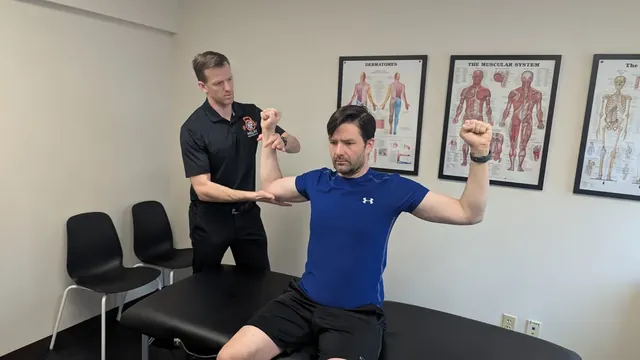
Chiropractic for shoulder pain treats the three things that usually hurt together: the shoulder joint, the soft tissue around it, and the nerves that reach the arm from the neck. A sports chiropractor uses joint adjustments, hands-on soft tissue work, and movement to relieve pain and restore your reach, usually over 4 to 8 visits.
Whether you're an overhead athlete or someone who can't reach the top shelf without wincing, shoulder pain has a way of shrinking your day. You start dressing with one arm, sleeping on the other side, and skipping the things that made your shoulder feel useful in the first place.
In my practice at Helms Performance in Bethesda, MD, shoulder pain rarely comes from just one source. The joint, the muscles and tendons around it, the upper back, and the neck all take turns causing trouble, and they usually do it together. That is why I look at all of them before I treat any of them.
A sore shoulder is usually a joint problem, a soft tissue problem, and a neck problem at the same time, and chiropractic care can address all three in the same visit.
What Does Chiropractic for Shoulder Pain Actually Do?
The shoulder is the most mobile joint in your body, and it pays for that freedom with very little built-in stability. It relies on a ring of muscles and tendons called the rotator cuff, on the shoulder blade sliding smoothly over the ribs, and on a neck and upper back that move well enough to let the arm reach overhead. When any of those stiffen up, the shoulder joint takes the extra load.
Here is how I address each layer.
- The joint. Adjustments and mobilization, meaning precise hands-on movement of a stiff joint, restore motion to the shoulder itself, the joint where the collarbone meets the shoulder blade, the upper back, and the neck. A stiff upper back alone can cost you the last few inches of overhead reach.
- The soft tissue. Active Release Technique, a massage and movement-based technique that treats problems with muscles, tendons, ligaments, fascia, and nerves, releases the stuck spots in the rotator cuff, the chest muscles, and the muscles around the shoulder blade. Dry needling, a thin filament placed into a tight muscle knot, helps when a muscle will not let go.
- The nerves. The nerves that run the arm leave the spine at the neck. When a stiff neck joint or a tight neck muscle irritates them, the pain shows up in the shoulder even though the shoulder itself is fine. Treating the neck fixes a surprising share of "shoulder" pain.
Which Shoulder Pain Patterns Respond to Chiropractic Care?
Not every shoulder problem is a chiropractic problem, but many of the most common ones are. Here is how the patterns I see most often tend to feel, and what helps.
| Pattern | How it usually feels | What helps |
|---|---|---|
| Pinching with overhead reach | A catch at the top of the shoulder when you lift the arm, reach behind you, or put on a jacket | Freeing the upper back and shoulder blade, releasing the rotator cuff and chest muscles |
| Rotator cuff irritation | A deep ache on the outside of the shoulder, worse at night and when lying on it | Soft tissue work on the cuff, joint mobilization, then strengthening |
| Neck-driven shoulder pain | Shoulder ache with neck stiffness, sometimes tingling down the arm | Treating the neck joints and muscles first, then the shoulder |
| Desk shoulder | A burning ache across the top of the shoulder and around the shoulder blade by the end of the workday | Releasing the upper trapezius and chest, restoring upper back motion |
| Frozen shoulder | Gradual loss of motion in every direction, stiff more than painful in later stages | Gentle joint mobilization and movement over several months, with realistic expectations |
A shoulder that will not lift at all after a fall, a shoulder that has popped out of place, or pain with fever, unexplained weight loss, or chest symptoms needs a physician first, not a chiropractor.
What Does a Shoulder Pain Assessment Look Like at Helms Performance?
Your first visit starts with a conversation. I want to know when the pain started, what makes it worse, whether it wakes you at night, and what you are trying to get back to, whether that is a tennis serve or lifting a grandchild.
Then I look at the whole chain. That means:
- Your neck. I check whether turning or tilting your head changes the shoulder pain. If it does, the neck is part of the problem.
- Your upper back and shoulder blade. I watch how the shoulder blade moves as you raise your arm. A blade that hikes up or wings out tells me the shoulder is compensating.
- The shoulder joint itself. Range of motion in every direction, and a few specific tests that tell me whether the rotator cuff, the biceps tendon, or the joint is the sore part.
- Strength. Simple resisted movements that show me which muscles are weak, which are guarding, and which are doing another muscle's job.
Most patients receive hands-on treatment during that first hour, not just an exam. Before you leave, you will know what is driving the pain, what we are going to do about it, and roughly how many visits it should take. If anything in the exam suggests a significant tear or a problem that needs imaging, I will tell you and point you to the right specialist. Our shoulder pain in Bethesda, MD page covers the common causes in more detail.
When Is Chiropractic Combined With Physical Therapy?
Almost always, for shoulders. Chiropractic care addresses the joints, the soft tissue, and the nervous system. It relieves pain and restores the motion the shoulder has lost. Physical therapy addresses movement, strength, and control. It teaches the rotator cuff and the muscles around the shoulder blade to hold the joint steady so the pain does not come back.
A shoulder that has been sore for months has usually lost both motion and strength. Restoring motion without rebuilding strength gives you a shoulder that feels better for a week and then tightens up again. Building strength on a joint that cannot move properly just irritates it. The two disciplines belong together, and at Helms Performance both are available in the same visit, so you get the right tool for the stage you are in. You can read more about how they differ on our sports chiropractic and sports physical therapy pages.
What Should You Expect Over a Course of Treatment?
Most of the shoulder problems I see improve over 4 to 8 visits spread across 4 to 8 weeks. Pinching with overhead reach and neck-driven shoulder pain tend to change quickly, often within the first 2 or 3 visits. Rotator cuff tendon problems take longer, because tendons heal slowly and need steady, progressive loading. Frozen shoulder is measured in months, and I will tell you that honestly at the first visit rather than promise a quick fix.
Early visits lean on hands-on care to relieve pain and restore motion. As the shoulder frees up, visits shift toward strengthening and the movements you actually need, whether that is a swim stroke or reaching into the back seat. You will have a short set of exercises to do between visits. Doing them is what makes the change last.
Every visit is a full hour, one-on-one with me, at a flat fee of $165. We do not bill insurance directly. You can pay with an HSA or FSA card, and we provide a superbill, an itemized receipt you can submit to your insurer for out-of-network reimbursement.
Dr. Paul Helms is a sports chiropractor at Helms Performance in Bethesda, MD, with advanced training in Active Release Technique, dry needling, and sports physical therapy. He works with patients across the whole range, from desk workers and retirees to professional athletes in the NFL and NBA.
Final Thoughts from Dr. Helms
If your shoulder has been nagging you for more than a couple of weeks, the most useful thing I can tell you is that it is probably not just your shoulder. The neck, the upper back, and the shoulder blade are almost always part of the story, and treating the sore spot alone is why so many people feel better briefly and then slide back.
Let us look at the whole chain and build a plan that fits your life. Whether you want to get back to throwing, swimming, or simply reaching the top shelf without thinking about it, we will help you get back to work, back in the game, and back to the activities you love.