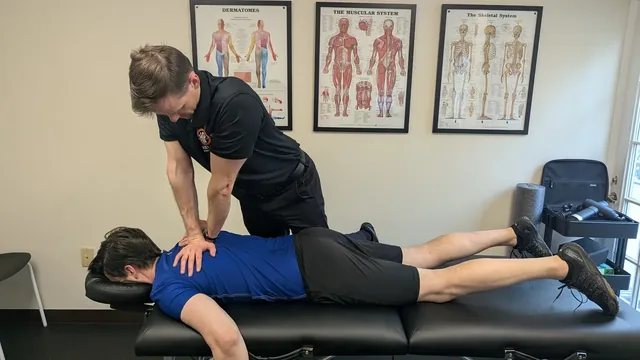
A sports chiropractor is a chiropractor with additional training in movement mechanics, soft tissue treatment, and the injury patterns that show up in bodies under load. A sports chiropractor still adjusts the spine and joints, and also treats the muscles, tendons, and nerves around them, then works on the movement pattern that created the problem.
The name puts a lot of people off, and it should not. Whether you are a masters swimmer with a cranky shoulder or someone who simply wants to lift a laundry basket without your lower back objecting, what you need is the same. Someone who checks how the whole thing moves before deciding what to treat. Here is what that actually looks like, in plain English.
What Is a Sports Chiropractor?
Start with what is shared. Every chiropractor, sports-focused or not, holds a Doctor of Chiropractic degree and is licensed to assess and treat the spine, joints, and the nervous system. Adjustments are common ground.
What a sports chiropractor adds is a second half of the toolkit and a different set of questions. The tools include soft tissue techniques such as Active Release Technique, which is a massage and movement-based method for treating problems with muscles, tendons, ligaments, fascia, and nerves, and often dry needling, which uses a thin filament needle to release a tight band inside a muscle. The questions are about load: what were you asking that joint to do, how often, and with what around it helping or not helping.
In my practice at Helms Performance, the shoulder is the clearest example. Shoulder pain that has not responded to anything is very often a neck and mid-back problem wearing a shoulder costume. Adjusting the shoulder alone gives a good afternoon. Treating the neck, the mid-back, and the soft tissue that has tightened around all of it is what gives a good month.
Same license, wider toolkit. A sports chiropractor treats the joint, the tissue around it, and the movement that overloaded both.
How Is a Sports Chiropractor Different From a General Chiropractor?
| Sports Chiropractor | General Chiropractor | |
|---|---|---|
| License | Doctor of Chiropractic | Doctor of Chiropractic |
| Adjustments | Yes | Yes |
| Soft tissue work | Central to the visit, often ART and dry needling | Varies widely by practice |
| Assessment | Whole movement chain under load | Usually focused on the spine and the painful area |
| What you leave with | Treatment plus corrective movement work | Treatment, and sometimes exercises |
This is a description of training and emphasis, not a ranking. Plenty of general chiropractors do excellent work, and plenty use these tools too. The point is to know what you are booking. If you are also deciding between disciplines, our guide on sports chiropractic versus physical therapy lays out where each one fits.
Do You Have to Be an Athlete to See a Sports Chiropractor?
No, and most of the people in our schedule are not. The sports lens is really a movement lens, and everybody moves.
- Desk workers with neck stiffness, tension headaches, and a mid-back that stopped rotating years ago.
- Runners and cyclists with hip and knee issues that flare every training block.
- Adults in their 60s and 70s whose stiffness has quietly narrowed what they are willing to do.
- Parents carrying, lifting, and twisting all day on one side.
- People who have tried rest and stretching and watched the same problem come back anyway.
Dr. Helms has worked with patients ranging from weekend walkers to professional athletes in the NFL and NBA. He brings the same attention to a 70-year-old managing sciatica as to a competitive athlete before a season, and the practice is built to welcome both.
What Does a Sports Chiropractor Actually Do in a Visit?
A visit at Helms Performance is one hour, one-on-one with Dr. Helms. Treatment starts on day one in most cases, so you are not paying for an appointment that only produces a follow-up booking.
- Step 1. History. What is happening, how long, what makes it better or worse, and what you have already tried.
- Step 2. Movement assessment. How the whole chain moves, not only the area you pointed at.
- Step 3. Hands-on evaluation. Joint mobility, tissue tenderness, and nerve function in the region involved.
- Step 4. Treatment. Adjustments where a joint is restricted, soft tissue work such as ART or myofascial release where the tissue is, and dry needling when a trigger point is driving it.
- Step 5. The plan. What is going on, what we are doing about it, and roughly how many visits it usually takes.
What Conditions Does a Sports Chiropractor Treat?
- Lower back pain, including sciatica that radiates into the leg.
- Neck pain, stiffness, and headaches that originate in the neck.
- Shoulder pain, rotator cuff irritation, and overhead restriction.
- Hip pain and hip flexor tightness from sitting or from running.
- Knee pain, assessed from the hip and ankle as well as the knee itself.
- Sprains, strains, and overuse injuries.
- Joint stiffness that limits ordinary things such as reaching a top shelf.
Our sports chiropractic page covers each of these in more depth, including which technique tends to be reached for first.
How Do You Choose a Sports Chiropractor?
Four questions worth asking before you book anywhere:
- Who treats me? Some offices assess with the doctor and hand you to an assistant. Ask.
- How long is the visit? A movement assessment plus treatment does not fit into ten minutes.
- What soft tissue training do you have? Certification in Active Release Technique and a dry needling license are specific, checkable answers.
- How many visits, roughly? A good answer is a range with a reason behind it, not an open-ended package.
One caution. If your pain came on suddenly, followed a fall or a crash, or comes with numbness, weakness, or fever, get evaluated before booking any hands-on care. If Dr. Helms finds something that belongs with another specialist, he will say so and help coordinate the referral.
How Much Does a Sports Chiropractor Cost in Bethesda, MD?
A visit at Helms Performance is a flat $165 for one full hour with Dr. Helms. We do not bill insurance directly. You can pay with an HSA or FSA card, and we provide a superbill, an itemized receipt with treatment codes that you can submit to your insurer for possible reimbursement. Coverage varies by plan, so check yours first.
No referral is needed and same-day appointments are often available. Because Helms Performance offers sports physical therapy alongside chiropractic, your care can move between the two as it progresses instead of restarting somewhere else.
Final Thoughts from Dr. Helms
An adjustment is a good tool. It is one tool. The reason the sports training matters is that it adds the soft tissue work and the movement retraining that keep the joint from going back to where it was by Thursday.
Whether you are getting ready for a season or just want to garden for an hour without paying for it the next morning, an honest exam at Helms Performance in Bethesda, MD will tell you what is really driving the problem. If chiropractic is not the right answer for you, we will tell you that too.