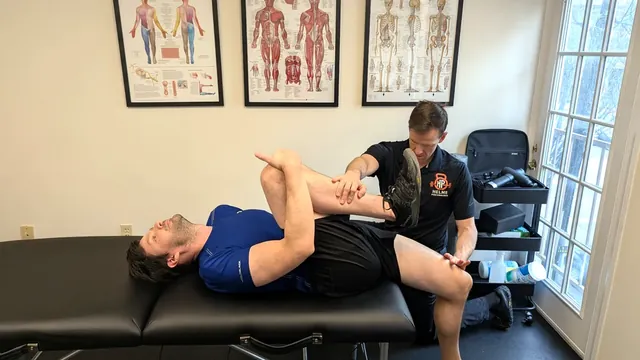
Active Release Technique for sciatica helps when tight muscles in the hip and buttock, especially the piriformis, are pressing on the sciatic nerve. ART releases that tissue and helps the nerve glide freely again. It is not the first step when a disc in the low back is the cause, so an exam comes before any treatment.
Whether you feel it on mile two of a run, halfway through a long car ride to the beach, or every time you get up from your desk, sciatica has a way of taking over your day. The pain might sit deep in your buttock, or it might shoot down the back of your leg toward your foot.
In my practice at Helms Performance in Bethesda, MD, I see two very different kinds of sciatica. In one, the nerve is irritated near the spine, often by a disc. In the other, the nerve is being squeezed lower down, by tight muscles deep in the hip. They can feel almost the same, and they need different plans. Active Release Technique is one of the best tools I have for the second kind.
When tight hip muscles are squeezing the sciatic nerve, ART frees the tissue around the nerve, and the exam first tells us whether that is really what is going on.
How Does Active Release Technique Help Sciatica?
Active Release Technique, or ART, is a massage and movement-based technique that treats problems with muscles, tendons, ligaments, fascia, and nerves. I hold precise pressure on a restricted spot while you move your leg through a specific motion.
The sciatic nerve is the largest nerve in the body. It leaves the low back, travels through the buttock, and runs down the back of the leg. On its way through the buttock, it passes right next to the piriformis and several other small hip muscles. When those muscles tighten or develop adhesions, meaning small patches of dense, sticky tissue, they can press on the nerve or keep it from sliding as you move.
ART goes after both problems. It releases the tight muscle, and because you move during the treatment, it also helps the nerve glide through the surrounding tissue. Many patients describe it as the leg finally feeling "unstuck."
Is Your Sciatica Coming From Your Back or Your Hip?
This is the most important question, and it is why I never treat sciatica without an exam first. Here are the patterns I look for. They are clues, not a diagnosis.
| Clue | More likely from the hip muscles | More likely from the low back |
|---|---|---|
| Where it hurts most | Deep in the buttock | Low back, with pain down the leg |
| What makes it worse | Sitting on a hard chair, crossing your legs, climbing stairs | Bending forward, coughing, sneezing |
| Pressing on the buttock | Often reproduces the pain | Usually does not change much |
| Numbness or weakness | Less common | More common, sometimes into the foot |
Many people have a bit of both. When the back is involved, ART on the hip can still be part of the plan, alongside other care for the spine.
Some symptoms need emergency care the same day: numbness around the groin or inner thighs, a new problem controlling your bladder or bowels, or a leg or foot that is quickly getting weaker. Please do not wait on those. Our sciatica treatment in Bethesda, MD page covers the common causes in more detail.
Which Muscles Does ART Target for Sciatica?
- Piriformis. A small, deep muscle that runs from the base of the spine to the outside of the hip. The sciatic nerve passes right beside it, and in some people through it.
- The other deep hip rotators. A group of small muscles just below the piriformis that can tighten after long hours of sitting or repetitive running.
- Hamstrings. The nerve runs down between them, and tight, stuck hamstrings can keep it from sliding when you bend forward or straighten your knee.
- Glutes. Tightness in the larger buttock muscles often adds to the pressure and the deep ache.
Should You See a Chiropractor for Sciatica or Get ART?
At Helms Performance, you do not have to choose. ART treats the muscles and the nerve's path through them. Chiropractic adjustments treat the joints of the low back and pelvis. When sciatica has a joint component and a muscle component, both are available in the same visit. Our guide can a chiropractor help with sciatica explains the joint side.
For very deep trigger points that ART has trouble reaching, dry needling for sciatica is another option. Between visits, a few targeted sciatica stretches help keep the progress going.
What Should You Expect From ART for Sciatica?
Your first visit is an evaluation and a treatment in the same hour. I check your back, hips, strength, reflexes, and how the nerve responds to movement. If ART is the right tool, we start that day. You will feel deep, firm pressure in the buttock for a few seconds at a time, and you can ask for lighter pressure whenever you need it. Mild soreness for a day or two is normal. A walk that evening helps it settle.
When tight hip muscles are the main cause, most patients notice meaningful improvement within 2 to 4 visits, and a full course usually runs 2 to 6. Every visit is a full hour at a flat fee of $165. Our Active Release Technique service in Bethesda, MD page covers the full approach.
Dr. Paul Helms is a sports chiropractor at Helms Performance in Bethesda, MD, with advanced certification in Active Release Technique and training in dry needling and sports physical therapy. He works with patients across the whole range, from desk workers and retirees to professional athletes in the NFL and NBA.
Dr. Paul's Final Thoughts
Sciatica is a symptom, not a diagnosis. The leg pain tells us the nerve is unhappy, but not where the problem is. When the answer is tight tissue deep in the hip, ART is one of the most direct ways to give the nerve room again.
Start with a good exam. Whether you want to get back to running or just want to sit through a movie without shifting in your seat, we will help you get back to work, back in the game, and back to the activities you love.