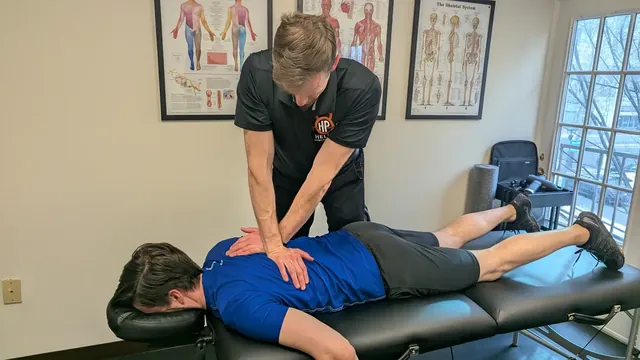
Can a chiropractor help with sciatica? Yes, for most people. A sports chiropractor treats sciatica by restoring motion to stiff lower back and pelvic joints, releasing the hip muscles that crowd the sciatic nerve, and guiding movement that calms the nerve down. Most patients notice a change within 3 to 4 visits.
Whether you're a runner whose leg goes numb at mile four or a desk worker who can't sit through a meeting without shifting in your chair, sciatica has a way of taking over your day. Sleep gets harder, the commute gets longer, and you start planning around the pain.
In my practice at Helms Performance in Bethesda, MD, sciatica is one of the most common reasons people come in, and one of the most rewarding to treat. The pain is intense, but the nerve is usually irritated, not damaged, and irritated nerves tend to settle once you take the pressure off them.
Chiropractic care helps sciatica by taking pressure off the sciatic nerve at the spine and the hip, and physical therapy keeps that pressure from coming back.
Can a Chiropractor Help with Sciatica?
Sciatica describes a set of symptoms: pain, tingling, or numbness that travels along the sciatic nerve from the lower back, through the buttock, and down the leg. The nerve gets irritated somewhere along that path, and the most useful thing anyone can do is find where.
The research supports a careful, hands-on approach. Spinal manipulation, meaning a precise, controlled movement of a stiff spinal joint, has been shown in studies to relieve sciatica in many patients. In one often-cited 2010 study of people whose sciatica had not improved with medication, about 60% did as well with chiropractic spinal manipulation as they would have with surgery. Most sciatica also improves on its own over 6 to 12 weeks. Good care helps you feel better sooner and lowers the odds of a repeat episode.
What Does Chiropractic Address in Sciatica Cases?
The sciatic nerve can be irritated at a few different points. Each one needs a slightly different plan.
| Where the nerve is irritated | How it usually feels | What chiropractic care does |
|---|---|---|
| Disc in the lower back | Leg pain worse with sitting, bending, coughing, or sneezing | Gentle mobilization and positions that move pain out of the leg and back toward the spine |
| Stiff lower back or pelvic joint | Back and buttock ache with pain into the thigh, worse after standing still | Adjustments to restore motion to the stiff joint |
| Tight hip muscles (piriformis) | Deep buttock pain, worse sitting on a hard chair or after a run | Active Release Technique and soft tissue work to free the nerve's path |
| Narrowed spinal canal (stenosis) | Leg heaviness with walking that eases when you sit or lean forward | Mobilization and flexion-based movement, common in adults over 60 |
Many people have more than one of these at once. That is normal, and it is why the exam matters more than the label.
Active Release Technique is a massage and movement-based technique that treats problems with muscles, tendons, ligaments, fascia, and nerves. For sciatica, I use it on the piriformis and the deep hip muscles, which sit right next to the nerve and can squeeze it when they tighten.
What Does a Sciatica Assessment Look Like at Helms Performance?
Your first visit starts with your story. When did the pain start? What makes it worse? Does it go below the knee? What are you trying to get back to, whether that is a long run or sitting through your grandchild's recital?
Then I check four things:
- Your lower back. How it bends and twists, and whether certain movements send pain down the leg or pull it back toward the spine.
- The nerve itself. Gentle leg raises and stretches show how sensitive the nerve is and where it is getting caught.
- Strength, reflexes, and sensation. These tell me whether the nerve is only irritated or starting to lose function, which changes the plan.
- Your hips and pelvis. Tight hip muscles and stiff pelvic joints are a common, and often missed, part of sciatica.
Most patients receive hands-on treatment that same hour. Before you leave, you will know where the nerve is irritated, what we are doing about it, and roughly how long it should take. Our sciatica treatment in Bethesda, MD page covers the common causes in more detail.
One situation is urgent rather than a booking. Numbness around the groin or inner thighs, a new problem controlling your bladder or bowels, or a leg or foot that is quickly getting weaker needs emergency care the same day.
When Is Chiropractic Combined with Physical Therapy or Dry Needling?
Usually. Chiropractic care relieves the pain and restores the motion that sciatica takes away. Sports physical therapy rebuilds the core and hip strength that protects the nerve, so the pain does not return the next time you lift a suitcase or sit through a long flight. Having both under one roof means you get the right tool for the stage you are in, without a second referral.
Dry needling is a thin, solid filament placed into a tight muscle knot to help it release. When a deep hip muscle will not let go with hands-on work alone, dry needling often reaches it faster. You can read more in our post on dry needling for sciatica.
What Should You Expect Over a Course of Treatment?
Most patients notice a change within 3 to 4 visits. A full course is often 6 to 8 visits over 6 to 12 weeks, depending on the source and how long the pain has been there. Leg symptoms usually ease first, pulling back toward the buttock and lower back. That is a good sign, even if the back still aches for a while.
Early visits focus on calming the nerve. Later visits shift to strength and the movements you need for your life. Between visits, you will have a short home routine, and our guide to sciatica stretches shows the ones I use most. If you feel a little sore after a visit, an easy walk is usually the best thing you can do.
Every visit is a full hour, one-on-one with me, at a flat fee of $165. We do not bill insurance directly. You can pay with an HSA or FSA card, and we provide a superbill you can submit for out-of-network reimbursement.
Final Thoughts from Dr. Helms
Sciatica feels scary because the pain is so sharp and travels so far. The good news is that most cases respond well to care that finds the source and takes the pressure off the nerve. Rest alone rarely does that, and neither does stretching the wrong thing.
Let us find where your nerve is getting caught and build a plan that fits your life. We will help you get back to work, back in the game, and back to the activities you love.