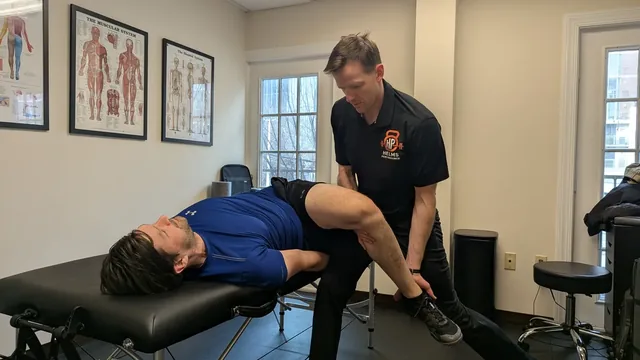
Sciatica stretches help most when they gently open the hip and lower back without pulling the irritated nerve tight. Four moves, held 30 seconds each and done once or twice a day, ease symptoms for many people. Stop any stretch that pushes pain further down the leg.
That last rule catches people out. Whether you are a runner whose calf goes numb at mile three or someone who cannot sit through the drive down Wisconsin Avenue without shifting in the seat, the instinct is to stretch harder into the pain. With a nerve, harder is usually backwards.
In my practice at Helms Performance in Bethesda, MD, I see the same story most weeks. Someone has been pulling aggressively into a hamstring stretch for a month, and the leg pain has slowly gotten worse. The stretch itself was reasonable. The way it was being done was tugging on a nerve that was already unhappy.
Good sciatica stretches pull symptoms back toward your lower back. Bad ones push them further down your leg.
What Do Sciatica Stretches Actually Do?
First, a quick translation. Sciatica is not a diagnosis. It is a description of pain that travels along the sciatic nerve, the thick nerve that runs from your lower back, through the buttock, and down the back of the leg. Something along that path is irritating it.
Usually it is one of three things. A disc in the lower back pressing on the nerve root, stiffness in the low back or hip joints, or a tight piriformis, which is a small muscle deep in the buttock that the sciatic nerve runs right beside.
Stretching helps with two of those. It restores motion in the hip and lower back so the nerve has more room, and it calms the muscles that are guarding around the area. What stretching does not do is change a disc. That is worth knowing before you decide how hard to pull.
Which Sciatica Stretches Are Worth Doing?
These four cover the common sources. Move into each one slowly until you feel a stretch, not a pull down the leg, then hold still. No bouncing.
- Supine piriformis stretch. Lie on your back, cross the sore-side ankle over the opposite knee to make a figure four, then reach through and draw the bottom thigh toward your chest. You should feel this deep in the buttock. Hold 30 seconds, 3 rounds per side.
- Single knee to chest. Lie on your back with both knees bent. Draw one knee toward the same-side shoulder, not straight up the middle. Gentle and low effort. Hold 30 seconds, 3 rounds per side.
- Nerve glide, seated. Sit tall in a chair. Straighten one knee while you tip your head back slightly, then bend the knee as you tuck your chin. Slow and smooth, about 2 seconds each way. This is a glide, not a stretch, so you are looking for easy movement and no lasting symptoms. 10 repetitions per side.
- Standing hip flexor stretch. Half-kneel or stand in a long stride, tuck your tailbone under, and press the back hip gently forward. Hold 30 seconds, 2 rounds per side. Tight hip flexors tilt the pelvis and load the lower back.
The whole set takes about 8 minutes. Do it once daily to start, and twice daily if it is going well. Getting up and walking for 5 minutes afterward matters as much as the stretching does.
Which Stretches Should You Skip With Sciatica?
A few popular ones tend to provoke the nerve rather than settle it, at least early on.
- Hard seated toe touches. Rounding the low back and hauling on a straight leg loads the disc and the nerve at the same time.
- Deep standing forward folds. Same problem, with gravity added.
- Bouncing into any stretch. Nerve tissue responds to slow and steady, never to repeated tugging.
- Aggressive spinal twists. Fine later for many people, often too much in the first couple of weeks.
- Stretching straight into the shooting pain. If the goal is to reproduce the symptom, you are training the nerve to stay sensitive.
How Do You Know If The Stretching Is Working?
Watch where the pain sits, not only how strong it is. Symptoms moving up toward the lower back is progress, even if the back itself feels a bit more sore for a few days.
| What you notice | What it usually means | What to do |
|---|---|---|
| Pain moves up toward the back | The nerve is calming down, even if the back feels achier | Keep going with the same routine |
| Pain travels further down the leg | That stretch is provoking the nerve | Stop that move and go back to the ones that felt easy |
| Eased during, back within an hour | Normal early on, the effect is short at first | Add a second short session later in the day |
| No change after 2 to 3 weeks | The source is likely not something stretching reaches | Get it examined rather than stretching harder |
This pattern, symptoms moving toward the spine rather than away from it, is one of the clearest signs we look for during an exam at Helms Performance in Bethesda, MD.
When Should You Stop And Get It Looked At?
Most sciatica settles with time and sensible movement. A few signs mean it is time for an exam rather than another week of stretching.
- Weakness in the leg or foot, such as catching a toe or struggling on stairs.
- Numbness that is spreading or is not going away.
- Pain that is clearly worse after two to three weeks of careful stretching.
- Pain that wakes you at night or is at its worst before you get out of bed.
- Symptoms that started with a fall or another specific injury.
One situation is urgent rather than a booking. Numbness around the groin or inner thighs, or a new problem controlling your bladder or bowels, needs emergency care the same day. That combination is rare, and it is not something to wait on.
Please do not try to work out the cause on your own. Telling a disc problem from a piriformis problem takes an exam, and the two are managed differently.
How Do Stretches Fit With Professional Care?
Stretching is the part you own. It keeps things moving and stops you from stiffening up while the nerve settles. What it cannot do is tell you where the irritation is coming from, and that is the piece that decides how quickly this resolves.
On a first visit we test the nerve, the joints above and below, and how you move, so the plan matches the actual source. From there, hands-on work opens the restricted tissue and specific exercise keeps it open. Our sciatica care in Bethesda, MD page walks through what that looks like, and if a muscle like the piriformis is a driver, dry needling for sciatica is often part of the answer. Visits run a full hour at a flat fee of $165. We do not take insurance, so the hour stays yours, and HSA and FSA cards are welcome.
Dr. Paul Helms is a sports chiropractor and physical therapist in Bethesda, MD with advanced training in Active Release Technique, a massage and movement-based technique that treats problems with muscles, tendons, ligaments, fascia, and nerves. He works with the full range of patients, from people who want to garden again without the leg going numb to professional athletes. You can also see how sports physical therapy fits alongside that.
Dr. Paul's Final Thoughts
Do the four stretches. Hold them for 30 seconds, keep the effort gentle, and walk afterward. Then pay attention to direction. Symptoms drawing back toward your lower back is the signal you want, and symptoms running further down the leg is the signal to back off.
If you have given it two or three honest weeks and the leg is no better, stretching more is not the next step. Come get it looked at. Whether you are training for a fall half marathon or simply want to sit through a movie without shifting every ten minutes, we will help you get back to work, back in the game, and back to the activities you love.