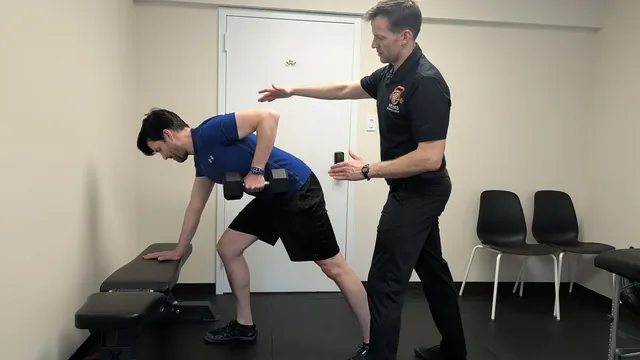
Sports physical therapy is movement rehabilitation delivered by a clinician trained in athletic injury patterns. It combines a whole-body movement assessment, hands-on manual therapy, and progressively harder exercise to treat what is causing the pain rather than only the spot that hurts. The word sports describes the clinician's training, not who is allowed to book.
That last point is the one worth sitting with. Whether you are working back from an ACL reconstruction or you just want to get off the floor after playing with a grandchild without your knee protesting, the process looks remarkably similar. Assess how the whole body moves, treat what is restricted, then load it until it holds. Here is a plain-English walk through what that actually involves.
What Is Sports Physical Therapy, Exactly?
Physical therapy in general is the discipline of restoring movement and function. Sports physical therapy is the branch of it built around how the body behaves under load: how a hip handles a stride, how a shoulder handles an overhead reach, how an ankle handles an uneven sidewalk.
Two terms are worth defining before we go further. Manual therapy means hands-on work such as joint mobilization and soft tissue treatment to reduce pain and free up restricted movement. Therapeutic exercise means specific movements prescribed to rebuild strength and control, progressed as you improve rather than handed over as a fixed sheet.
In my practice at Helms Performance, the most common thing I find is that the painful area is not the guilty area. Knee pain that turns out to be a hip that is not doing its share. Shoulder pain that traces back to a mid-back that has stopped rotating. This is why the assessment covers the whole chain rather than the one joint you pointed at.
Sports physical therapy asks why the tissue got overloaded in the first place, then rebuilds the strength and movement that keeps it from happening again.
Do You Have to Be an Athlete for Sports Physical Therapy?
No, and the assumption that you do keeps a lot of people from getting help they would benefit from. Dr. Helms has worked with professional athletes in the NFL, NBA, and CrossFit, and he brings the same attention to a 68-year-old managing sciatica. The range is the credential, not the filter.
The people who walk through the door here in Bethesda, MD look like this:
- Desk workers whose neck and upper back tighten every week and whose forearms ache by Friday.
- Recreational runners and lifters with a recurring injury that flares every training block.
- Older adults who want stairs, gardening, and grocery bags to stop being a negotiation.
- Postpartum parents rebuilding after nine months of changing load and a lot of one-sided carrying.
- People recovering from surgery who have been cleared and now need someone to guide the loading.
If your body has to do something and it currently hurts to do it, you are in the right category.
What Happens in a Sports Physical Therapy Session?
A visit at Helms Performance is one hour, one-on-one with Dr. Helms. There are no aides and no handoffs. The person who assessed you is the person treating you.
- Step 1. The conversation. What hurts, how long, what makes it better or worse, and what you are trying to get back to. The last one shapes everything else.
- Step 2. The movement assessment. Strength, mobility, and how the whole chain behaves, not just the painful joint.
- Step 3. Hands-on treatment, the same day. Joint mobilization, soft tissue work, or Active Release Technique, which is a massage and movement-based method for treating muscles, tendons, ligaments, fascia, and nerves.
- Step 4. Your exercises. Usually two or three things, chosen for your specific problem, with a clear reason for each one.
- Step 5. The plan. A realistic timeline and what the next few weeks look like, before you leave.
You should leave the first visit with a sense of direction, not just a sore area and a follow-up booking.
How Is Sports Physical Therapy Different From Sports Chiropractic?
These are two distinct disciplines that are often mentioned in one breath. The short version is that one restores joint function and one restores movement capacity.
| Sports Physical Therapy | Sports Chiropractic | |
|---|---|---|
| Main focus | Movement rehabilitation and functional strength | The spine, joints, and nervous system |
| Core tools | Therapeutic exercise, manual therapy, movement retraining | Spinal and joint adjustments, ART, dry needling |
| Best suited for | Rebuilding capacity once pain is settling | Acute pain, joint restriction, nerve symptoms |
| What success looks like | You can load it again without it flaring | The joint moves freely and the pain signal quiets |
Most patients need parts of both. Because Helms Performance offers both, Dr. Helms can shift between them visit to visit instead of sending you across town. Our full sports chiropractic versus physical therapy guide goes deeper if you are trying to decide where to start.
What Conditions Does Sports Physical Therapy Treat?
- Knee pain, including pain on stairs, when bending, or after sitting too long.
- Lower back pain and sciatica.
- Hip pain and hip flexor tightness.
- Shoulder pain, rotator cuff irritation, and overhead impingement.
- Ankle sprains and the chronic instability that follows repeated ones.
- Post-surgical recovery after ACL reconstruction, rotator cuff repair, or joint replacement.
- Neck pain and tension headaches linked to posture and joint restriction.
- Overuse injuries such as IT band syndrome, patellar tendinopathy, plantar fasciitis, and tennis elbow.
Details on each of these live on our sports physical therapy page, along with what a typical plan looks like.
One caution worth stating plainly. If your pain started suddenly, followed a fall or a crash, or comes with numbness, weakness, or fever, get evaluated before you book anything hands-on. If Dr. Helms finds something that belongs with another specialist, he will tell you and help coordinate it.
How Long Does Sports Physical Therapy Take to Work?
For an acute injury or a straightforward muscle problem, many patients notice a difference within the first two to four sessions. Chronic conditions and post-surgical rehabilitation take longer, often six to twelve weeks of consistent work, because you are rebuilding capacity rather than calming an irritation.
Anyone who promises a specific number before examining you is guessing. Dr. Helms gives you a realistic estimate at the first visit and adjusts it as you go.
How Much Does Sports Physical Therapy Cost in Bethesda, MD?
A visit at Helms Performance is a flat $165 for one full hour with Dr. Helms. We do not bill insurance directly. You can pay with an HSA or FSA card, and we provide a superbill, which is an itemized receipt with treatment codes that you can submit to your insurer for possible reimbursement. Coverage varies widely by plan, so check yours before assuming either way.
Dr. Paul's Final Thoughts
The most useful thing about a sports-trained lens is not the sports. It is the habit of asking what the tissue was being asked to do when it gave up, and then making it strong enough for that job again.
Whether you are aiming at a start line in the spring or simply want to sleep through the night without your shoulder waking you, an honest movement assessment at Helms Performance in Bethesda, MD is a good place to begin. You will leave knowing what is going on and what we are going to do about it.