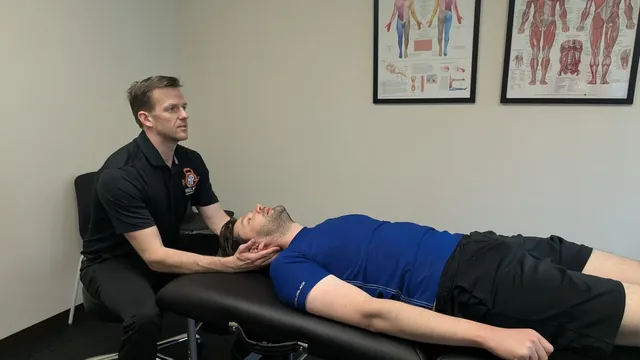
TMJ exercises retrain the jaw to open and close on a straight, even path instead of a painful or clicking one. A 5 minute routine of controlled opening, gentle resistance, and tongue position, done twice a day, eases jaw pain for many people over 3 to 4 weeks.
Jaw pain has a way of following you through the day. Whether you are an athlete who clenches through a heavy lift or someone who grinds through a stressful week of meetings, it shows up in eating, talking, and sleeping. Small, frequent, low-effort work tends to help more than anything forceful.
In my practice at Helms Performance in Bethesda, MD, the detail patients are most surprised by is the neck. People arrive expecting me to work only on the jaw, and a good share of the improvement comes from the upper neck and head position instead. The two are mechanically linked.
These exercises train control, not force. Small movements done often beat big movements done hard.
What Do TMJ Exercises Actually Do?
The temporomandibular joint, or TMJ, is the hinge just in front of each ear where your jaw meets your skull. Inside it sits a small disc that should glide smoothly as you open. When the muscles around the joint pull unevenly, that glide gets rough, which is where clicking, catching, and pain tend to come from.
These exercises do three things. They train the jaw to open on a straight line rather than veering to one side, they build gentle control in the muscles that steady the joint, and they break the clenching habit that keeps the whole area loaded. Notice that none of those involve stretching the jaw open hard. Forcing range is the fastest way to irritate this joint.
Which TMJ Exercises Should You Start With?
Do these in front of a mirror to start, because seeing the jaw drift is what teaches you to correct it. Everything here should be comfortable. Pain means back off.
- Resting position. Lips together, teeth slightly apart, tongue resting on the roof of your mouth just behind the front teeth. This is where your jaw should sit all day. Check in on it a few times an hour.
- Controlled opening. Hold that tongue position and open slowly, only as far as the tongue stays on the roof of your mouth. Watch the mirror and keep the jaw straight. 6 slow repetitions.
- Gentle resisted opening. Place your thumb under your chin and open against light pressure, about the effort it takes to hold a coffee cup. Hold 5 seconds, 5 repetitions.
- Gentle resisted closing. Pinch your chin between thumb and finger and close against light pressure. Hold 5 seconds, 5 repetitions.
- Side-to-side control. Place an object about a quarter inch thick between your front teeth and move the jaw slowly left and right. 10 repetitions.
- Chin tuck. Sitting tall, draw your chin straight back to make a double chin without tipping your head. Hold 5 seconds, 10 repetitions. This is the neck piece, and it matters more than people expect.
The whole routine takes about 5 minutes. Twice a day is plenty. If your jaw feels tired afterward, that is fine. If it feels sore, use less pressure next time.
Why Does Your Neck Posture Change Your Jaw?
When your head drifts forward over a laptop, the muscles under your jaw are put on a stretch and the resting position of the lower jaw shifts backward. Your bite changes slightly, the joint sits differently, and the muscles that close the jaw end up working from a poor starting position all day.
This is why the chin tuck is on the list, and why treatment often includes the upper neck. If you also get headaches or stiffness at the base of the skull, our neck pain page is worth a look, because the two problems usually travel together.
What Should You Avoid While Your Jaw Settles?
The exercises help most when you stop feeding the problem the rest of the day.
- Chewing gum. Hours of low-level loading on a joint you are trying to calm.
- Hard and chewy foods. Bagels, tough steak, crusty bread, and ice. Cut food smaller for a few weeks.
- Wide unsupported yawns. Rest a fist gently under the chin when you feel one coming.
- Resting your chin in your hand. Common at a desk, and it pushes the joint sideways for long stretches.
- Sleeping face down. This turns the head and loads one joint all night.
- Nail biting and pen chewing. Small habits, steady load.
How Long Before TMJ Exercises Help?
Progress here is gradual, and the first thing to change is usually how the jaw moves rather than how much it hurts.
| Timeframe | What to expect | What to adjust |
|---|---|---|
| Week 1 | You start catching yourself clenching, pain much the same | Focus on resting position and the daytime habits |
| Week 2 | Opening feels straighter, mornings less stiff | Keep the routine at twice daily |
| Weeks 3 to 4 | Many people notice less pain with eating and talking | Add the chin tuck through the workday |
| Past 4 weeks, no change | Something else is likely involved | Get it evaluated, and mention any grinding at night |
Clicking often improves more slowly than pain, and some clicking can remain even when the jaw feels comfortable again.
When Should You Stop And Get It Looked At?
Most jaw pain responds well to gentle work. A few situations need a professional rather than another week of exercises.
- A jaw that locks, either stuck open or unable to open more than a couple of finger widths.
- Pain that is clearly worse after two to three weeks of careful, gentle work.
- Swelling, warmth, or a fever around the joint.
- Worsening headaches, dizziness, or new ear symptoms such as ringing or fullness.
- Jaw pain that started after a blow to the face or jaw.
Sorting out a jaw problem often takes more than one professional. A dentist looks at your bite, grinding, and whether a night guard would help, while we look at the joint, the muscles, and the neck. If you grind at night, please start with your dentist. Please do not try to diagnose the cause yourself, since jaw pain, ear pain, and headaches overlap a great deal.
How Do These Exercises Fit With Professional Care?
The exercises are the daily habit that keeps things moving. Care is what finds the reason the jaw started pulling unevenly, which is usually some combination of muscle tension, joint stiffness, and neck position.
On a first visit we look at how the jaw tracks when you open, how the upper neck moves, and which muscles are doing too much. From there, manual therapy, meaning skilled hands-on treatment of joints and soft tissue, settles the area, and dry needling can help when the masseter or temporalis, the two large chewing muscles at the cheek and temple, stay tight. Our TMJ care in Bethesda, MD page explains the full approach. Visits run a full hour at a flat fee of $165, and HSA and FSA cards are welcome.
Dr. Paul Helms is a sports chiropractor and physical therapist at Helms Performance in Bethesda, MD, with advanced training in dry needling and manual therapy. He works with patients across the whole range, from people who clench through a stressful work week to professional athletes.
Dr. Paul's Final Thoughts
Start with resting position. Lips together, teeth apart, tongue on the roof of your mouth. If you did nothing else on this list, that habit alone would help, because most jaws are quietly loaded all day.
Then add the 5 minute routine twice daily, keep every effort light, and drop the gum. Give it three or four weeks. If the jaw is no better, or if it locks at any point, come get it looked at rather than pushing through. Whether you are getting back to a full training week or simply want to eat a sandwich without thinking about it, we will help you get back to work, back in the game, and back to the activities you love.