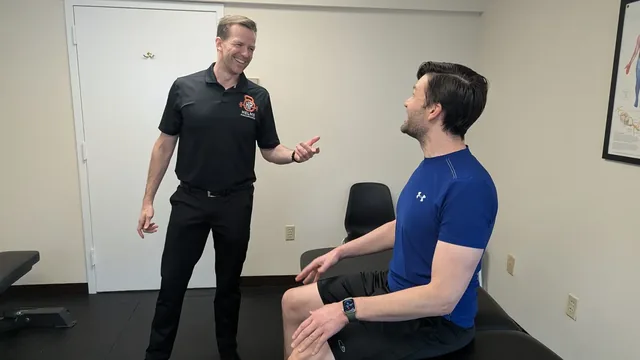
Physical therapy for vertigo starts with a one hour first visit in four parts: a conversation about when the dizziness shows up, a short lying-down test for the inner ear, a neck exam, and treatment the same day. Most people leave with a clear cause, treatment already started, and a short home program.
Not knowing what is coming is half the dread of a vertigo appointment. Whether you are a cyclist who felt the world tilt on a descent or a grandparent who has been holding the wall on the way to the bathroom at night, you want to know what will happen in the room and whether it will make you dizzy.
In my practice at Helms Performance in Bethesda, MD, I tell every new vertigo patient the same thing before we start: some of what we do today will bring on your dizziness on purpose, briefly, because that is how we find the cause. Here is the visit in order, so nothing is a surprise.
The first visit finds the cause, treats it the same day, and sends you home with a plan. Brief dizziness during testing is expected and useful.
What Is Physical Therapy for Vertigo?
Physical therapy for vertigo is hands-on treatment for spinning and unsteadiness, followed by a short home program that helps the relief last. At Helms Performance, it focuses on the two causes we see most.
The first is BPPV, where tiny calcium crystals in the inner ear drift out of place and trigger spinning when you tilt your head. The second is neck-related dizziness, where stiff upper neck joints send the brain a position signal that disagrees with the eyes and inner ear. Each has its own test and its own treatment, which is why the first visit is built around telling them apart.
What Happens in the First 15 Minutes?
The visit starts with a conversation, and it matters more than most people expect. Dr. Helms wants to know when the dizziness began, whether it spins or just feels off, how long each episode lasts, and what sets it off: rolling over, looking up, standing quickly, turning your head, or a long day at a screen. He will ask about hearing changes, headaches, recent illness, falls, and any medications you take.
Woven into that conversation is a red-flag screen. A few causes of dizziness need a physician rather than a therapist, and a short set of questions plus a quick check of your eyes, speech, strength, and coordination rules those out. If anything points that way, you are referred first and treated later.
What Do the Positional Tests Feel Like?
This is the part people worry about. The main test is called the Dix-Hallpike. You sit on the table, turn your head about 45 degrees to one side, and Dr. Helms guides you back to lying down with your head tilted slightly below the edge of the table, supported the whole way. He watches your eyes for a specific flicking movement called nystagmus while you report what you feel.
If BPPV is present on that side, you will feel a burst of the spinning you came in with. It usually starts after a few seconds and fades within 30 to 60 seconds. The direction of the eye movement tells him which ear and which canal are involved, and that decides the treatment. A second test, lying flat and turning the head side to side, checks a different canal. Both sides are tested. If nothing spins, that is useful too, because it points the exam toward the neck.
Why Does a Vertigo Exam Include Your Neck?
Because the inner ear is not the only place dizziness can start. The neck exam checks how far your head turns, how the upper joints move under gentle pressure, and whether the small muscles at the base of the skull are tender. Dr. Helms also uses a few gentle tests to see whether moving your neck, and not your inner ear, brings on the dizziness.
Together with the positional tests, the neck exam shows whether your dizziness is coming from the ear or the neck. Roughly speaking, short spinning bursts with position changes point to the ear, and steady unsteadiness that travels with stiffness and headaches points to the neck. For most people it is one or the other.
Does Treatment Start on the First Visit?
Yes, in nearly every case. If the test shows BPPV, the treatment is a repositioning maneuver, most often the Epley. You move through four head and body positions on the table, each held for about 30 seconds, while gravity guides the crystals out of the canal. It takes a few minutes, and it usually brings on one more short burst of spinning on the way through.
If the neck is the cause, hands-on care begins the same day: gentle mobilization of the upper neck joints and soft tissue work for the muscles that hold your head position. This can include Active Release Technique, a massage and movement-based technique for tight muscles, and dry needling, which uses a very thin needle to help a tight muscle relax, when it is a good fit for you. Because Dr. Helms practices both sports physical therapy and sports chiropractic, you are tested for both causes and treated for the one you have in the same hour, in one office. Before you leave, you get a short home program. If you have BPPV, it is a set of clear instructions for the next two days. If the neck is the cause, it is two or three short neck exercises.
What Should You Do in the 48 Hours After?
- Expect some wooziness. A vague, off-balance feeling for a day or two after a repositioning maneuver is common and fades on its own.
- Take it easy for the rest of the day. After a repositioning maneuver, avoid quick head movements, bending to the floor, and tipping your head far back. Sleeping slightly propped up the first night helps some people. You do not need to hold still, and normal walking is fine.
- If your neck was treated, start your home exercises. The two or three short drills take a few minutes, once or twice a day.
- Tell us if the spinning comes back. A second repositioning treatment is sometimes needed.
- Call if the spinning is clearly worse, lasts for hours, or comes with any new symptom such as headache, vision changes, or weakness.
How Should You Prepare for a Vertigo Appointment?
- Wear comfortable clothes you can lie down and move in.
- Eat a light meal beforehand. Testing on an empty or very full stomach makes nausea more likely.
- Bring a list of your medications and any recent imaging or ENT notes.
- If you take a motion-sickness medicine such as meclizine, ask the physician who prescribed it whether you can hold it before the visit. It can dull the eye movements the test relies on.
- If you are very dizzy right now, have someone drive you.
- Write down what sets it off. The pattern is the most useful thing you can bring.
How Many Visits Will You Need?
It depends on the cause, and you should know the answer before you leave the first visit.
| Cause | Typical course | What the visits involve |
|---|---|---|
| BPPV (loose inner ear crystals) | Most people need 1 to 3 visits. | Dr. Helms performs a repositioning maneuver, retests you at the next visit, and gives you clear instructions for home. |
| Neck-related dizziness | Most people improve over 2 to 6 weeks. | Dr. Helms treats the neck with hands-on care, adds dry needling where it fits, and teaches you short exercises that retrain your neck and posture. |
Each visit is one hour, one-on-one, at a flat fee of $165. We do not bill insurance directly, but HSA and FSA cards are welcome and we provide a superbill for your insurer. The full approach is on our vertigo physical therapy in Bethesda, MD page.
Dr. Paul Helms is a sports chiropractor and physical therapist at Helms Performance in Bethesda, MD, trained in repositioning treatment for BPPV and hands-on care for neck-related dizziness. He works with patients across the whole range, from older adults who want to feel steady on the stairs again to athletes whose balance is off on the field.
Final Thoughts from Dr. Helms
The first vertigo visit is mostly about answers. You should leave knowing whether it is the ear or the neck, with treatment already started and a realistic timeline instead of an open-ended plan.
If the spinning started this morning or you have been living with it for months, please do not try to sort out the cause yourself. Let us test it. Whether you want to get back to your morning run or simply want to roll over in bed without the room moving, we will help you get back to work, back in the game, and back to the activities you love.