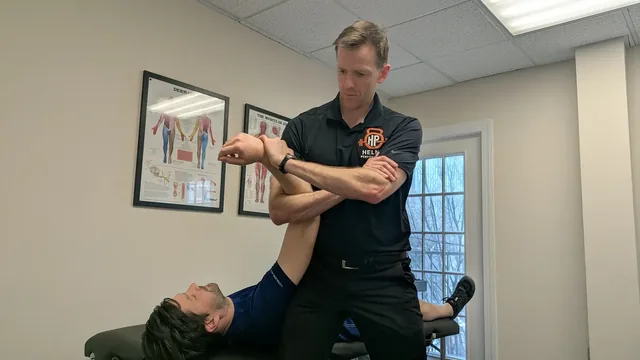
Self massage for tight muscles helps between professional visits by easing everyday tension and holding onto the range of motion you gained in your last session. Ten minutes on most days with a foam roller, a massage ball, and some gentle movement is enough. At-home work maintains progress, but it does not resolve a restriction that has been building for months.
You leave a massage feeling loose and easy. Two days later, the tightness starts creeping back. That is normal, and it does not mean the session failed. Whether you are a runner whose calves stiffen up by Wednesday or someone at a desk who feels the neck tension returning, the days between appointments are where progress is either kept or quietly lost.
In my practice at Helms Performance in Bethesda, MD, this is one of the most common questions I get. What can I do at home so this lasts longer? Quite a lot, as long as you know what the at-home work is for.
At-home massage is maintenance between visits. It keeps you comfortable and mobile, and it is not the thing that changes a long-standing restriction.
What Does Self Massage For Tight Muscles Actually Do?
When you press into a tight muscle, two useful things happen. Blood flow picks up, and your nervous system tends to turn down its protective guarding in that spot. That second part is likely the bigger effect, and it explains something people find confusing. The looseness is real, but it usually fades within a day.
That is not a failure of the tool. Think of at-home work as topping up a tank rather than repairing it. You keep tension from stacking up, which makes each professional session start from a better place. For a deeper look at the tools, our guide to self myofascial release covers what works and what does not.
One word worth translating. Fascia is the thin, web-like tissue that wraps every muscle and connects one area to the next, so myofascial simply means muscle and fascia together.
Which Tools Belong In Your At-Home Kit?
You do not need a closet full of gear. Three inexpensive items cover nearly everything, and each has a job it does better than the others.
- A foam roller. Best for big areas: quads, hamstrings, calves, and the upper back. The wide surface spreads pressure out, which makes it forgiving.
- A massage ball or tennis ball. Best for small, specific spots: the muscles around the shoulder blade, the glutes, and the sole of the foot. A ball reaches places a roller cannot.
- A wall. Not a purchase, but the most underrated option here. Pinning a ball between your shoulder and a wall gives you full control over pressure while standing, which is far easier on the knees and wrists than getting down on the floor.
A massage gun is a nice extra rather than a starting point. The pressure is shallow compared with a steady held press. If you own one, use it for 30 to 60 seconds per area and keep it moving.
What Does A Ten-Minute Between-Visits Routine Look Like?
Here is the routine I hand to patients. Every step works standing, sitting, or on the floor, so pick the version your body prefers. Spend the time listed, then move on. Longer is not better.
- Foam roller, upper back. Lie back over the roller placed across your mid-back, support your head with your hands, and breathe slowly. 60 seconds. Four to five days a week.
- Massage ball against a wall, shoulder blade area. Pin the ball between the wall and the muscle just inside your shoulder blade. Lean in gently, find one tender spot, and hold. 45 to 60 seconds per side. Four to five days a week.
- Foam roller, quads and hamstrings. Roll slowly until you find the one spot that feels different, then rest there. 60 seconds per leg. Three to four days a week.
- Massage ball, glutes. Sit on a firm chair with the ball under one back pocket, or lie on the floor if that is comfortable. Hold steady pressure. 60 seconds per side. Three to four days a week.
- Hands or roller, calves. Sitting in a chair, cross one ankle over the opposite knee and squeeze the calf firmly with both hands, working from the ankle upward. 60 seconds per leg. Three days a week.
- Massage ball, sole of the foot. Seated, roll the ball slowly under the arch of your foot with light pressure. 45 seconds per foot. Daily.
- Finish with movement. Ten slow sit-to-stands from a chair, or a five-minute walk. Every time. Movement is what tells your body to keep the range you just gained.
Two rules for all of it. Keep the discomfort around a 4 or 5 out of 10, where you can still breathe normally and hold a conversation. And hold, do not saw. Rapid back-and-forth rolling never stays in one place long enough to matter.
Stay off bone, off the front of the neck, and off the places where nerves sit close to the surface: behind the knee, the inside of the elbow, and the crease at the front of the hip.
How Often Should You Do This, And When?
Ten minutes on four or five days a week suits most people. That is enough to keep tension from stacking up without irritating tissue that is already working hard.
- The day of your appointment. Light work is fine beforehand. Save the deeper pressure for another day.
- The first day or two after. Go easy on whatever was treated. That tissue is already responding, and heavy pressure on top of it tends to increase soreness. Walking, gentle range of motion, and water serve you better in that window.
- Days three through seven. This is where the routine above earns its keep, when old tension usually starts creeping back.
If an area feels sorer or tighter the next morning, you used too much pressure. Take a day off and go lighter next time. Bruising is not a sign that it worked.
When Should You Stop And Have It Looked At?
At-home work is safe for ordinary muscular tightness. A few things are signals to stop and get evaluated.
- Pain that gets worse as you work on it, or worse over the following days.
- Numbness or tingling anywhere.
- Pain that travels down an arm or a leg.
- The same spot returning within a day or two, every week, for more than a month.
- Pain that wakes you at night, or that is there before you get out of bed.
- Visible swelling, a joint that feels unsteady, or pain that started with a specific injury.
None of these mean something is seriously wrong. They mean the problem has moved past what a ball and a roller can reach. Please do not try to work out the cause on your own. That is what an exam is for.
How Does At-Home Work Fit With Professional Massage?
The two are partners, not alternatives. In a session we find where the problem actually lives, which is frequently not where it hurts. Tight calves are often a hip issue. Hands feel tissue change and adjust angle and depth in real time. A roller cannot do that, and neither can you on yourself, because you cannot fully relax against your own body weight.
Our myofascial massage sessions are built around finding and treating that source, and myofascial release adds steady, specific pressure held while the tissue gradually gives way. Visits run a full hour at a flat fee of $165. We do not accept insurance, so the hour stays yours. HSA and FSA cards are welcome, and we are glad to provide a superbill for out-of-network reimbursement.
Dr. Paul Helms is a sports chiropractor and physical therapist in Bethesda, MD with advanced training in Active Release Technique, a massage and movement-based technique that treats problems with muscles, tendons, ligaments, fascia, and nerves. At Helms Performance he works with patients across the whole range, from people easing back into gardening to professional athletes. Most leave with two or three spots to work on at home and a list of the ones to leave alone.
Dr. Paul's Final Thoughts
Buy the roller. Buy the ball. Use them on most days for about ten minutes, keep the pressure moderate, and always move afterward. That is worth doing, and it will make you feel better between visits.
Just hold the right expectation. At-home massage maintains what you already have. It will not undo something that took months to build, and extra pressure will not change that. When the same spot keeps coming back no matter how patiently you work on it, have someone look at it. Whether you are training for a fall half marathon or simply want to lift a grandchild without your shoulder complaining, we will help you get back to work, back in the game, and back to the activities you love.