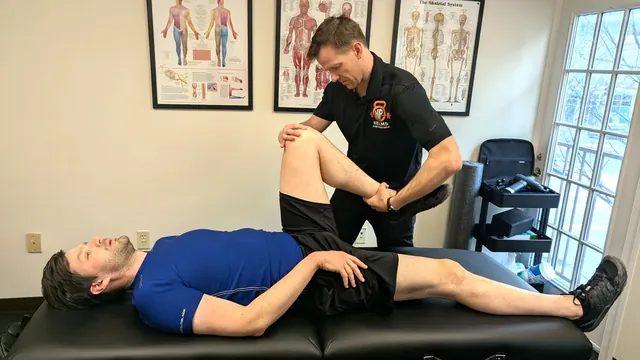
A knee pain location chart matches where your knee hurts to the structures most likely involved. Pain at the front points to the kneecap, the inside to the inner ligament or cartilage, the outside to the IT band, the back to the hamstring tendons or a fluid-filled cyst, and pain above or below the kneecap to a tendon.
Whether you're a runner whose knee starts aching at mile three or a grandparent who winces every time you kneel down to the floor, the first question is usually the same: what is actually wrong in there? Where it hurts is one of the most useful clues you have.
In my practice at Helms Performance in Bethesda, MD, the location of the pain gets me to a short list within the first few minutes. It does not give me the answer by itself. The hip, the ankle, and even the lower back all change how the knee loads, so the chart below is a starting point for a conversation, not a diagnosis.
Knee pain location narrows the list of likely causes, and a hands-on exam tells you which one is actually yours.
Knee Pain Location Chart: What Each Area Means
Here are the five main areas and what usually causes pain in each one. Find the row that matches where you feel it most.
| Where it hurts | Common causes | How it usually feels |
|---|---|---|
| Front, around or behind the kneecap | Kneecap irritation (patellofemoral pain), early arthritis behind the kneecap | A dull ache on stairs, squats, or after sitting a long time with bent knees |
| Inside (medial) | Inner ligament (MCL) sprain, medial meniscus, pes anserine bursitis, arthritis | Sharp with twisting, or an ache just below the inner joint line |
| Outside (lateral) | IT band irritation, outer ligament (LCL) sprain, lateral meniscus | A burning or sharp spot on the outer knee, often at the same point in every run or ride |
| Behind (posterior) | Baker's cyst, hamstring or calf tendon strain, back of the meniscus | Tightness or fullness behind the knee, worse when fully bending or straightening |
| Above or below the kneecap | Quadriceps tendon (above), patellar tendon or "jumper's knee" (below) | A pinpoint ache that warms up during activity and returns afterward |
Pain everywhere at once, or pain that moves around, often points to arthritis, swelling inside the joint, or a problem that starts at the hip or lower back.
What Does Pain on the Inside of the Knee Mean?
Inner knee pain is the location I see most often in adults over 50. Three causes cover most of it.
- Medial meniscus. The meniscus is a C-shaped cushion of cartilage between the thigh bone and shin bone. Irritation usually feels sharp with twisting or deep squatting, and sometimes the knee catches.
- MCL sprain. The medial collateral ligament runs down the inside of the knee. It usually follows a clear moment, like a sideways hit in soccer or a slip on ice.
- Pes anserine bursitis. A small fluid sac sits about 2 to 3 inches below the inner joint line, under three tendons. It gets tender with stairs and is common in runners and in people with knee arthritis.
Inner knee arthritis is also common, and it usually feels stiff in the morning and achy after a long walk.
What Does Pain on the Outside of the Knee Mean?
Outer knee pain in an active person is most often IT band syndrome. The iliotibial band is a long, thick strip of tissue running from the hip down the outside of the thigh. When it gets irritated where it crosses the knee, runners and cyclists feel a sharp or burning spot that shows up at a predictable point in the workout. The real driver is usually weak hip muscles letting the knee drift inward, which is why we spend as much time on the hip as on the knee.
An outer ligament (LCL) sprain or a lateral meniscus problem is less common and usually follows a specific twist or impact.
What Does Pain Behind the Knee Mean?
Pain behind the knee often comes from a Baker's cyst, a pocket of joint fluid that bulges into the back of the knee when something inside the joint is irritated. It feels tight or full, especially when you fully bend or straighten the leg. Strains of the hamstring or calf tendons, which attach just above and below the back of the knee, are the other common cause, especially in runners and people who sit for long stretches.
One situation is urgent. A swollen, warm, red, or tender calf below a painful knee can be a blood clot. That needs a physician the same day, not a booking with us.
What Does Pain Above or Below the Kneecap Mean?
Pinpoint pain just below the kneecap is usually patellar tendinopathy, often called jumper's knee. Tendinopathy means a tendon has been loaded faster than it could adapt. Basketball and volleyball players get it often, and I also see it in people who started a new workout class or spent a weekend gardening on their knees. Pain just above the kneecap is the same problem in the quadriceps tendon.
Tendons respond well to gradual, progressive loading. Rest makes them feel better briefly but leaves them weaker, which is why the pain comes back. In teenagers, a sore bump below the kneecap is often Osgood-Schlatter disease, an irritated growth plate that settles with time and smart activity changes.
When Should You Stop Guessing and See a Provider?
A chart is helpful for understanding your knee. It cannot examine it. Get your knee checked if:
- It swelled quickly after an injury. Swelling within a few hours often means bleeding inside the joint.
- It locks, catches, or gives way. That can point to a torn meniscus or ligament.
- You cannot put weight on it, or it looks out of shape after a fall.
- It is hot, red, and you have a fever. That needs a physician the same day.
- It has not improved after 2 weeks of easing off the activity that bothers it.
At Helms Performance, a first visit is a full hour, one-on-one with me, at a flat fee of $165. I look at the hip, ankle, and lower back along with the knee, and most patients receive hands-on treatment that same visit. Our knee pain treatment in Bethesda, MD page covers how we combine sports chiropractic and sports physical therapy to relieve pain and rebuild strength. If the exam suggests a tear that needs imaging, I will tell you and point you to the right specialist.
Dr. Paul's Final Thoughts
Knowing where your knee hurts is a smart first step, and it makes our first conversation faster and more useful. But the knee is usually where the pain shows up, not where the problem starts. A weak hip, a stiff ankle, or an irritated nerve in the lower back can all send trouble to the knee.
Whether you want to get back to running, playing with your kids, or climbing the stairs without holding the railing, we will help you get back to work, back in the game, and back to the activities you love.