Hip flexor pain is usually felt at the front of the hip, in the crease where the thigh meets the body, and sometimes down the upper thigh. It often comes from a tight, overworked, or strained muscle. Most cases improve with hands-on treatment, smart strengthening, and a few changes to how long you sit.
Whether you're training for a race or sitting at a desk all day, the hip flexors work hard. They lift your knee with every step, every pedal stroke, and every time you climb the stairs. When they get irritated, you feel it when you stand up from a chair, step into the car, or try to pick up your pace.
In my practice at Helms Performance in Bethesda, MD, hip flexor pain shows up in two very different groups of people. Runners, cyclists, and soccer players often overload the muscle. Desk workers and long-distance drivers often feel it after months of sitting. The good news is that both groups usually respond well to the same basic plan.
Hip flexor pain is front-of-hip pain from the muscles that lift your knee, and an exam helps tell it apart from problems in the hip joint or low back.
What Is Hip Flexor Pain?
The hip flexors are a group of muscles that bend the hip, meaning they bring your knee up toward your chest. The biggest one is the iliopsoas, a combination of two muscles. The psoas starts on the front of the lower spine, and the iliacus lines the inside of the pelvis. They join together and attach to the top of the thigh bone.
The rectus femoris, one of the quadriceps muscles on the front of the thigh, also helps. So do two smaller muscles near the outside and front of the hip. Hip flexor pain means one or more of these muscles, or the tendons that attach them to bone, has become irritated, tight, or strained.
Where Is Hip Flexor Pain Felt, and What Does That Mean?
Where you feel the pain gives useful clues. These are patterns I look for, not a diagnosis.
| Where you feel it | What it often points to |
|---|---|
| Front of the hip, in the crease | The iliopsoas muscle or tendon, the most common source |
| Upper front of the thigh | The rectus femoris, often after sprinting or kicking |
| Deep in the groin, with clicking or catching | Possibly the hip joint itself, which needs a closer look |
| Front of the hip plus the low back | The psoas, the lower spine, or both working together |
Many people have more than one of these at once. A hands-on exam sorts out which one is driving the pain.
Hip flexor pain tends to flare when you lift your knee, stand up after sitting, walk uphill, or take your first few steps in the morning. Hip pain when walking that eases once you warm up often points to the muscle. Pain that gets steadily worse the longer you walk deserves a closer look.
What Causes Hip Flexor Pain?
- Long hours of sitting. Sitting keeps the hip bent for hours at a time. Many people notice their hips feel stiff and tight when they finally stand up.
- Overuse. Running, cycling, rowing, and hiking all repeat the same hip-lifting motion thousands of times. A quick jump in mileage or hills is a common trigger.
- A sudden strain. A hip flexor strain is a small tear in the muscle fibers, often from sprinting, kicking, or slipping. It usually hurts right away.
- Weak glutes and core. When the muscles on the back of the hip and around the trunk are not doing their share, the hip flexors pick up the slack.
- A stiff low back or pelvis. The psoas attaches to the lower spine, so back stiffness and hip flexor tightness often travel together.
Some hip pain is not the hip flexors at all. Arthritis, a labral tear (an injury to the ring of cartilage around the hip socket), and pinched nerves in the low back can all cause pain at the front of the hip. Please get checked the same day if you cannot put weight on the leg, especially after a fall, or if hip pain comes with fever, major swelling, or pain at night that does not change with position.
How Is Hip Flexor Pain Treated at Helms Performance?
Your first visit starts with a full exam of your hip, low back, and pelvis. I check strength, range of motion, and how the hip moves when you walk, squat, and step. That tells us whether we are dealing with the muscle, the joint, the spine, or a mix. We usually start treatment that same day.
Because Helms Performance offers both sports chiropractic and sports physical therapy under one roof, your plan can include:
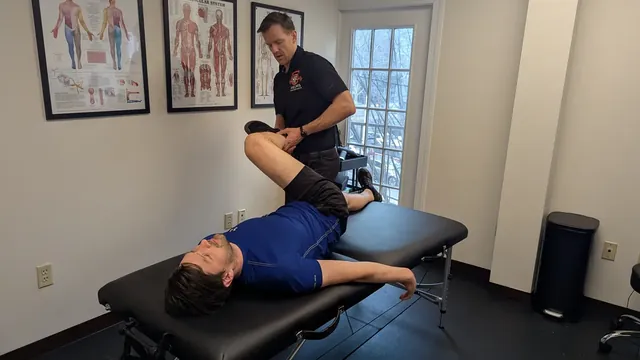
- Active Release Technique. A massage and movement-based technique that treats problems with muscles, tendons, ligaments, fascia, and nerves. I hold pressure on the tight spot while you move your leg.
- Myofascial release and dry needling. Hands-on and needle-based ways to relax deep muscle tension that is hard to reach.
- Chiropractic adjustments. Gentle joint work for the low back and pelvis when stiffness there is adding to the problem.
- Sports physical therapy. A strengthening plan for the hip flexors, glutes, and core so the pain is less likely to come back.
Every visit is a full hour at a flat fee of $165. Our hip pain treatment in Bethesda, MD page covers the other common causes of hip pain, and our Active Release Technique page explains the hands-on side in more detail.
Dr. Paul Helms is a sports chiropractor at Helms Performance in Bethesda, MD, with advanced training in Active Release Technique, dry needling, and sports physical therapy. He works with patients across the whole range, from desk workers and retirees to professional athletes in the NFL and NBA.
What Can You Do for Hip Flexor Pain Between Appointments?
- Break up long sitting. Stand up and walk for a minute or two every 30 to 60 minutes. A timer helps.
- Try a gentle half-kneeling stretch. Kneel on the sore side, step the other foot forward, and squeeze the glute on the kneeling side until you feel a mild stretch at the front of the hip. Hold for 30 seconds, two or three times. Skip it for the first few days after a fresh strain.
- Wake up your glutes. Glute bridges, lying on your back and lifting your hips, give the hip flexors some help. Start with 2 sets of 10.
- Keep moving. Easy walking usually helps more than resting completely. If you are a runner, cut back on hills and speed work until the pain settles.
If home care is not making a clear difference in two to three weeks, or the pain keeps coming back, it is time for a proper exam. Our sports physical therapy program builds the strength that keeps hip flexor pain from returning.
Final Thoughts from Dr. Helms
Hip flexor pain is common, and it is very treatable. The key is knowing whether the muscle is the real problem or just the place you feel it. Once we know that, the plan is usually simple: calm the tissue down, restore how the hip moves, and rebuild the strength around it.
Whether you want to get back to your long runs or just stand up from the couch without wincing, we will help you get back to work, back in the game, and back to the activities you love.