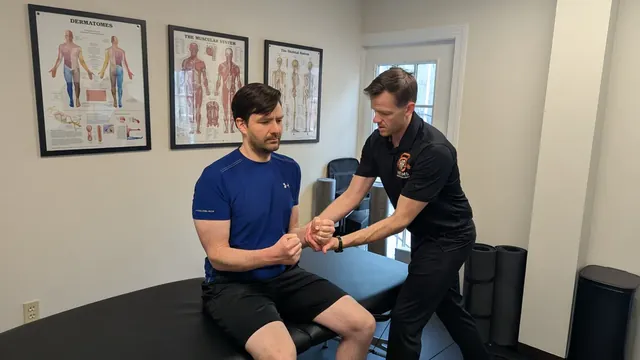
Active Release Technique for tennis elbow releases tight, stuck tissue in the forearm muscles that attach at the outside of the elbow, while you move your wrist and hand. The same approach works for golfer's elbow on the inside. Paired with grip strengthening, most patients notice meaningful improvement within 2 to 4 visits.
Whether it started with a new pickleball habit, a weekend of pulling weeds, or months of typing and clicking a mouse, tennis elbow tends to show up in the simplest moments. Lifting a coffee mug. Shaking hands. Turning a doorknob. It is frustrating how much a small spot on the elbow can get in the way.
In my practice at Helms Performance in Bethesda, MD, most tennis elbow patients have already tried rest, a brace, and maybe a cortisone shot. Many of them feel better for a while, then flare again as soon as they go back to what they love. The missing piece is usually the forearm muscles themselves, and that is where Active Release Technique comes in.
ART frees up the tight forearm tissue that keeps loading the sore spot at the elbow, and strength work helps the tendon handle everyday gripping again.
How Does Active Release Technique Help Tennis Elbow?
Active Release Technique, or ART, is a massage and movement-based technique that treats problems with muscles, tendons, ligaments, fascia, and nerves. I hold precise pressure on a restricted spot in the forearm while you move your wrist and fingers through a specific motion.
Tennis elbow, also called lateral epicondylitis, is an overuse problem in the tendon where the wrist and finger muscles attach to the outside of the elbow. Golfer's elbow, or medial epicondylitis, is the same kind of problem on the inside of the elbow. Despite the names, most people who have them do not play tennis or golf.
With repeated gripping, the forearm muscles tighten and develop adhesions, meaning small patches of dense, sticky tissue. Tight, stuck forearm muscles keep tugging on the tendon at the elbow, even when you are not doing much. ART releases that tissue, which takes some of the strain off the sore spot.
Tennis Elbow or Golfer's Elbow: Which One Do You Have?
| Tennis elbow | Golfer's elbow | |
|---|---|---|
| Where it hurts | Outside of the elbow | Inside of the elbow |
| Muscles involved | Wrist and finger extensors, on the back of the forearm | Wrist and finger flexors, on the palm side of the forearm |
| What makes it worse | Gripping with the palm down, lifting a mug, typing, a backhand | Gripping with the palm up, carrying bags, pulling, a golf swing |
| Who gets it | Desk workers, tradespeople, gardeners, racquet players | Lifters, climbers, golfers, parents carrying car seats |
ART treats both the same way: by finding and releasing the stuck forearm tissue that feeds into the painful tendon.
Is ART Different From Tennis Elbow Massage?
Yes, in two ways. A massage works across a broad area while you lie still. ART focuses on one restricted spot at a time, and you move your wrist and hand while I hold pressure there. That movement draws the tissue under my contact and helps it glide again, which a still massage does not do.
ART also reaches the spots that keep a tennis elbow flaring. Those are often a few inches below the elbow, in the meat of the forearm, rather than right on the tender bump. Many patients are surprised that the most useful work happens away from where they feel the pain.
Why Does Strength Work Matter for Tennis Elbow?
Tennis elbow is a load problem. The tendon got irritated because it was asked to do more than it was ready for. Releasing the forearm takes pressure off, but the tendon also needs to get stronger so everyday gripping stops bothering it.
That is why ART is almost never the whole plan. I pair it with a few simple, progressive grip and wrist exercises, starting light and building gradually. For many patients, the combination is what finally keeps the pain from coming back once they return to tennis, the garden, or the keyboard.
A few situations need a physician before any hands-on care: an elbow that is swollen or will not straighten after a fall, numbness or tingling into the ring and little fingers, or pain with fever and redness. If you are not sure where your pain fits, our elbow pain treatment in Bethesda, MD page walks through the common causes.
What Should You Expect From ART for Tennis Elbow?
Your first visit is an evaluation and a treatment in the same hour. I check your grip strength, the motion of your wrist and elbow, and your neck and shoulder, since tension higher up the arm can play a part too. Then we start. The forearm has little padding over it, so ART there can feel intense for a few seconds at a time. You can ask for lighter pressure whenever you need it. Mild soreness for a day or two is normal.
Most elbow problems take 2 to 6 visits, and many patients notice meaningful improvement within 2 to 4. Tennis elbow that has lingered for many months usually sits at the longer end. Every visit is a full hour at a flat fee of $165. Our Active Release Technique service in Bethesda, MD page covers the full approach.
Dr. Paul Helms is a sports chiropractor at Helms Performance in Bethesda, MD, with advanced certification in Active Release Technique and training in dry needling and sports physical therapy. He works with patients across the whole range, from desk workers and retirees to professional athletes in the NFL and NBA.
Final Thoughts from Dr. Helms
If your elbow keeps flaring every time you go back to normal life, rest alone has probably done all it can. The forearm needs to be released, and the tendon needs to be strengthened. ART plus a smart exercise plan covers both.
Whether you want to get back to your Saturday tennis game or just want to carry groceries without wincing, we will help you get back to work, back in the game, and back to the activities you love.